Creative Writing Research Success

F_C_BUCIU_POSTER_Final
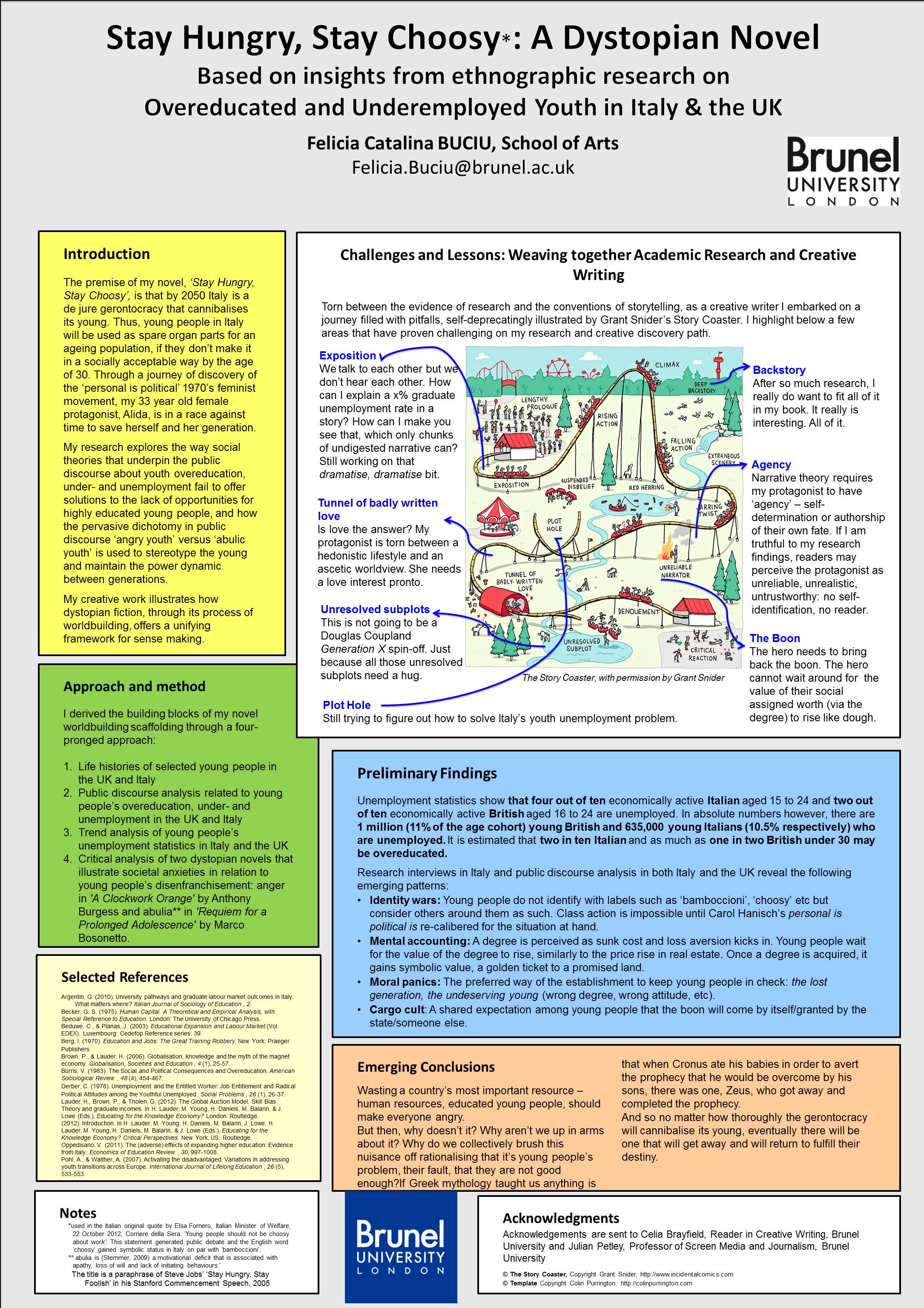
Please click on the image to view the winning poster

Creative Writing PhD student, Felicia Catalina Buciu, wins the Graduate School Research Poster Competition

I am absolutely delighted to win this research poster competition and represent the School of Arts and the Creative Writing programme. My PhD tutor, Celia Brayfield encouraged me to participate. Although I wasn’t keen on the idea at first, since I thought this was taking precious time away from writing my PhD novel, I trusted Celia’s recommendation that getting exposure to other people’s points of view was going to be worth the experience. Celia is a fantastic tutor with great insight into the publishing world as well as an outstanding teacher and mentor, so I knew her advice was worth its weight in gold.

Indeed, the poster conference was a great opportunity to engage with other PhD students and learn about their research projects but also a moment of reflection, listening to the judges’ questions and taking in their suggestions.

But most of all, I experienced the most exciting moment to me as a writer: talking to potential readers. The premise of my novel, ‘Stay Hungry, Stay Choosy’, is that by 2050 Italy is a de jure gerontocracy that cannibalises its young. Thus, young people in Italy will be used as spare organ parts for an ageing population, if they don’t make it in a socially acceptable way by the age of 30. Through a journey of discovery of the ‘personal is political’ 1970’s feminist movement, my 33 year old female protagonist, Alida, is in a race against time to save herself and her generation.

I was thrilled to see that my work in progress raised the visitors’ interest. I was also happy to be able to convey the potential for creative writing to use the universal language of storytelling and draw upon inter-disciplinary research to make sense of the world.

I endeavor to finish my novel by the end of this year and I look forward to working alongside my tutor, the wonderful and resourceful academic and support staff at the School of Arts and the exceptionally supportive staff at the Graduate School.

Please click on the image above to view the winning poster.
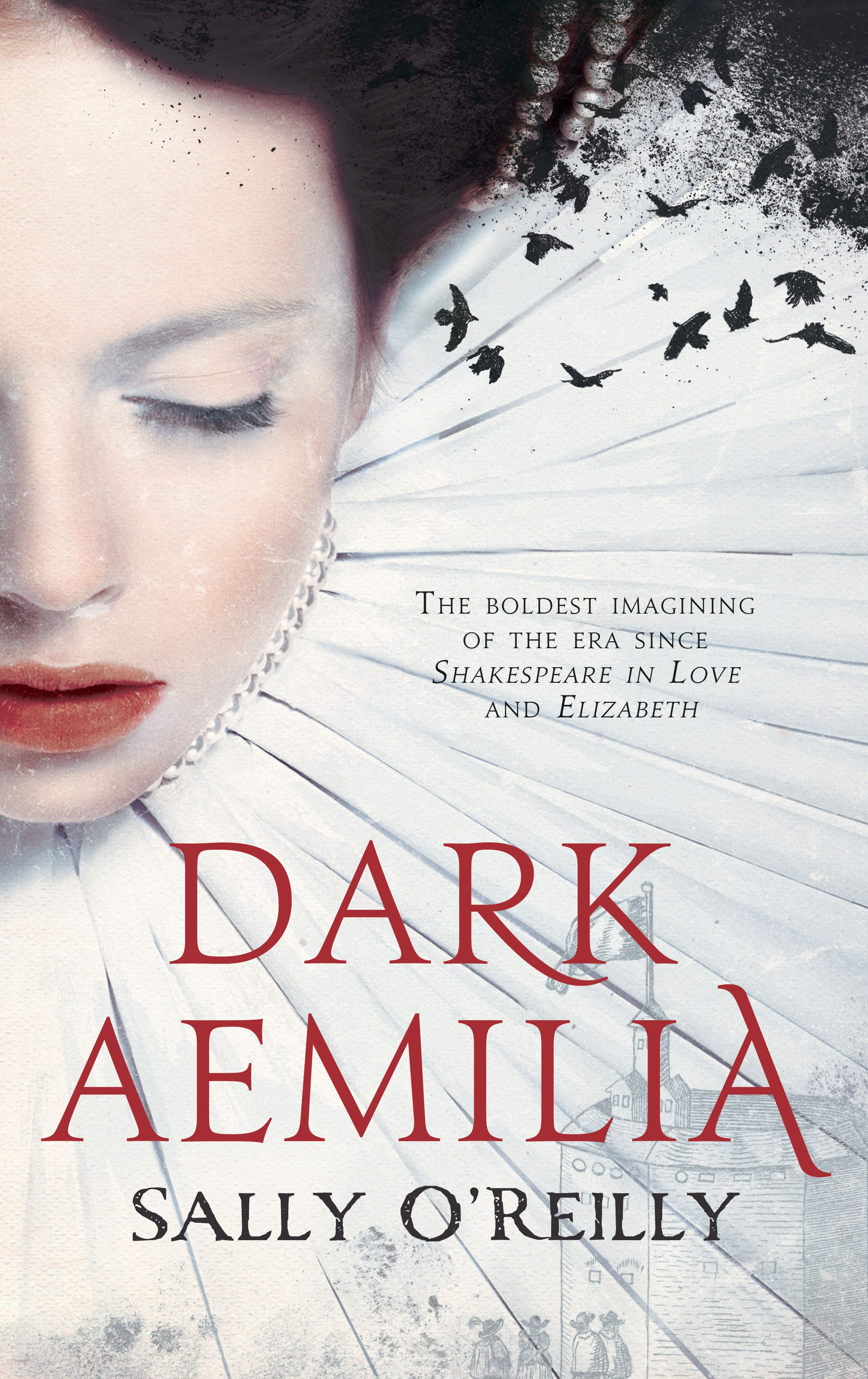
Dark Aemilia and the Creative Writing PhD by Sally O’Reilly

Dark_Aemilia

I enrolled on the MA Creative Writing, The Novel at Brunel after being published by Penguin books – and then dropped when my second book didn’t sell. I wanted to go back to basics, re-ignite my love for writing and develop a stronger awareness of genre and the commercial possibilities of writing. I enjoyed this experience so much that I ended up studying for a PhD and writing a historical novel about Aemilia Bassano Lanyer, one of several women who may have been Shakespeare’s muse and the inspiration for his later sonnets: his Dark Lady.

Writing fiction in an academic context was a major departure for me, and I found it challenging and strange to begin with. My first two novels were written instinctively and intuitively, and I was loathe to plot or plan anything. My third was carefully crafted, researched in great detail, and forced me to write in a way I had never tried before. I found that I could only make the story ‘live’ if I wrote it in the first person, and this meant trying to produce a convincing facsimile of a sixteenth century voice.

This would have seemed like an insurmountable problem if I had not had the support and advice of my supervisor Celia Brayfield and my second supervisor Dr Elizabeth Evenden, an expert in Early Modern writing and publishing.  They provided me with structure and feedback, asking pertinent questions about the direction of my draft and the rigour of my research, and giving me their notes and comments to help me shape and develop my drafts. One of the areas that really stretched me intellectually was the critical component of the work, which was an analysis of the various invented versions of Shakespeare which writers have imagined over the last two hundred years. I was fascinated by this, and it helped me invent my own version of Shakespeare with more confidence and sophistication. I realised that so little is known about this iconic figure that writers have carte blanche to concoct their own version, and to project their own fantasy of an uber English writer onto this empty space.

The result was not only a doctorate but a marketable novel I could be proud of. I found the writing and research process hugely rewarding – my time at Brunel was one of the most productive of my writing career so far. And I certainly succeeded in my goal of reinventing myself as historical fiction writer.

Dark Aemilia is published by Myriad Editions in the UK this month, and by Picador US in June. Rights have also been sold in Italy and Turkey.

Sally’s blog, How to be a Writer, is here.

The Voices Inside Our Heads

Brunel University’s first anthology of short stories by Creative Writing and Creative Writing & English Students at Brunel University

Anthology

BOOK LAUNCH 19th March 2014, 6pm, Antonin Artaud Building

Readings & Minglings

EVERYBODY WELCOME

Just turn up on the door

ENQUIRIES: brunelanthology2014@gmail.com

BOOKS will be ON SALE at £5 each

29 students, 29 stories

The characters in this superb book of short stories by Brunel undergrads range from a self-harming schoolboy to a Buddhist monk in Thailand; from cheating husbands to a mother hell-bent on plastic surgery. You’ll also find ghosts, broken relationships, loss of religious faith and a devastating flood in Burma, as well as fantasy fiction including a sea witch, a warrior girl who turns into a wolfhound and warring squirrels. You’ll come across quite a few crazies too, including a pathological liar, a serial killer, a boy stalker and a man whose itch gets so out of control he loses it completely.

Writers

Lauren Anderson, Neelam Appaddoo, Chloe Bines, Kirsty Capes, Charlotte Chappell, Stephanie Dickenson, Laura Dunnett, Emily Elicker, Mafaal Faal-Mason, Johno Fagan, Nathan Feldman, Vanessa Gibbs, Bryn Glover, Veronica Grubb, Sophie Hart, Emma Jeremy, Sophie Jones, Jemima Khalli, Molly McCabe, Rebecca Passmore, Rebecca Pizzey, Xenia Rimmer, Ashley Roye-Banton, Joanne Showunmi, Romany Stott, Samantha Symonds, Matthew Thomas, Hannah Varney, Rebbeca West

8 MINUTES IDLE In Cinemas Now

8-Minutes-Idle

8 Minutes Idle is a darkly romantic comedy about the perils and traumas of your first job – when enforced promotion, murderous parents, and homelessness get in the way of true love. Adapted by Brunel’s very own Matt Thorne from his novel, it tells the story of twenty-something Dan Thomas, who finds himself kicked out of the family home and faced with no option but to secretly move into the office where he works. It’s a funny, irreverent and moving UK film that combines a US indie vibe with a very British sense of humour. Watch the trailer here:

Inspiration

Inspiration can strike at any given moment, although it most likely will strike at a really inconvenient time. Unfortunately that’s just how inspiration is. Last term I was just sitting quietly in Starbucks when all of a sudden I had a great idea for a novel and a few characters. For those writers who don’t always carry a journal I highly recommend you do so you can avoid texting yourself the idea.

When you go for looking for inspiration you most likely won’t find it. Inspiration is a tricky little bugger. Fortunately, for the times when we are looking for inspiration, we can easily cultivate it.

  1. Music

The relationship between music and writers is often a fond one. Most writers nowadays have a playlist of music they create for each novel they write. This can be a really useful tool if you want to create a certain mood in your writing. If you still don’t have an idea for next writing piece, flash fiction exercises where you have to write down the first thing that comes to mind when listening to a piece of music can be a great way to get started.

  1. Photography

It is often said that one photograph is worth a thousand words. Photographs can provide you with a certain setting, mood or tone that you potentially could capture in your prose. A few good photography websites worth a look are the Lonely Planet and In-Public.

  1. Experience, experience, experience.

I am a firm believer in ‘write what you know.’ Writing from past or present experiences can provide you with interesting scenes in your prose that are unique to you.  Writing what you know can also make your writing more authentic and believable. This does not only apply to creating events and circumstances in your novel but can also be used to create characters. More often then not, when I am developing characters for my prose I take the traits and personality of my friends and family and mix them to create a realistic and interesting individual.

You can also gain inspiration many different ways but these are just a few to get you started. If you’re still staring at that blank page not ready to dive in at the deep end then try something on this list. You never know, you might just find you’ll be inspired.

Kate McKim.

English Swearing vs. Everyone Else

It’s boring getting told to “eff off”. I recently asked a friend of mine, who speaks a good four or so languages, what his favourite swear word was. He told me that he never bothered with English swear words because they’re too dull compared to the choice phrases he’s picked up elsewhere.

He may have a point. According to Slate.com, the most commonly used swear word on Facebook, in English, is ‘shit’. [1] The F-Bomb comes in a close second. Standard quadrilaterals. Most of our other curse words are seemingly just other names for our downstairs equipment. Add the word “off” to the end of nearly any four letter word and you’ve got a standard English curse, right?

So my friend demonstrated some of the more interesting insults and phrases that appear in other languages. The Greeks seem particularly adventurous, with one of my favourite phrases meaning ‘to slap your face with my dick’. Or even just the simple, yet effective, “old balls”. Most Italian insults seem to rely on everyone being a prostitute. Or even a pig-prostitute combination. A confusing Bosnian insult apparently implies a dog is taking advantage of your mother, although it’s “used by people who don’t want to curse”[2] (I might not start using that one instead of ‘damn!’).

In order to keep up, I propose that we get a little more saucy. This is a call to be more creative in your cussing. Call someone a ‘Stupid Quim’ an ‘Ass-Hat’, or a ‘Penis-Sneeze’. Express your surprise with a subtle “by st. Boogar and all the saints at the backside door of purgatory!” (which is apparently an established exclamation[3].) Curse someone with a “May the hairs on your arse turn to hammers and beat your balls to death.” It’ll certainly cause more of a pause in conversation than a standard ‘shit’.

See more interesting curses over at mentalfloss.com: http://mentalfloss.com/article/49652/10-old-fashioned-swears-spice-your-cussin

Calling All Students of English and Creative Writing!

Calling all students of English and Creative Writing!

The daunting time is approaching us as third year students, our futures must be decided!  This however seems certainly not the case for many of us but Wednesday 27th November may assist you in this transition to the next stage. The workshop has been arranged by the English Department and will focus on postgraduate study. Dr Nick Hubble and Matt Thorne will present the MAs that Brunel offer. If you are looking to continue your academic studies than this workshop is more than advised. Brunel offers 15% discounts to all its graduates who achieve firsts from Brunel and any other UK, EU or overseas university, so get studying!

Whether absolutely sure or not, if postgraduate study is an imaginable prospect for you, with PhD routes later, then do not fail to miss this workshop!

Wednesday 27th November, 2.30-4.30 in AA001.

Chelsey Owens-Power.

Motivation, Motivation, Motivation.

It’s cold. It’s raining. It’s miserable. You’re tucked up under a blanket watching Gavin and Stacey. It can be really hard to get up and sit at your laptop for hours writing something, whether it be for your own satisfaction or for university purposes. There’s no one there apart from yourself to push you and lack of motivation can be a real killer, especially when you’ve got a deadline looming and are feeling so snowed under by work, you can’t see the light at the end of the tunnel. Or you might be bursting with ideas, but can’t find a place to begin. Here are some top tips for jumping that first hurdle and settling down to some hard graft.

1. Get up!

It might be tempting to stay under your duvet (especially is a cold house – how expensive is heating??) and say to yourself, “I can do work here”, whilst balancing your laptop on your knees. Whilst that works for some people, it might actually be more beneficial for you to sit at a desk where it feels like you are actually about to do some work, rather than lounging around in bed where it feels like you should be watching a film. Once you’re sat upright, creative juices can flow and you’ll find that you get into a rhythm of typing.

2. Be patient!

It may seem like you will never reach the bottom of that metaphorical pile of work that seems to be towering above you. However, take it one step at a time! If you try to do everything at once, you’ll be going nowhere fast. Sit down and make a list before you even do anything, making sure you know which deadline comes where.

3. Take the pressure off.

It is so difficult to get started on an assignment, or any piece of work, if you’re more focused on pressuring yourself to finish rather than the piece of work itself. Yes, the piece might be due tomorrow and you’ve only just started (we’ve all done it) but panicking about it will only take up more time. Be focused, be chilled out. It WILL get done and it will take as long as it takes. You may just have to sacrifice a little bit of sleep. Somethings gotta give!

4. Try somewhere new.

Okay, so you’ve been sat at your desk for half an hour, staring at a blank word document. Move yourself to somewhere else! It might be just moving to a different part of your room, it might be putting your feet up on the desk. Or it might be leaving your house and taking a trip to the library. Brave the horrible weather and relocate yourself. Different surroundings might spring your brain into action.

5. Wake up earlier.

Lying in until 2pm is bliss, there’s no doubting that. But if you set your alarm for 10am, you’ve got the whole day ahead of you! It gives you more daylight hours (and let’s face it, we’re running low on daylight hours) to get the work done before it gets dark outside and you just want to have dinner and relax.

These tips may seem a little clichéd, but are SO easily forgotten when it comes to the crunch. Sometimes you just have to remind yourself that you DO know what you’re doing and that you need to calm down and get on with it. A little tough love on yourself may be the key.

Hilary Nouwens.

Writers’ & Artists’ Yearbook 2014 Short Story Competition

Getting published as a writer in this day and age is increasingly difficult. With so much talent and competition around, it can seem like an impossible task! It’s important for writers to get as much feedback as they possibly can, and perfect their skills to make sure all their work is as amazing as it can be. Since the internet has become a vital tool in networking and getting noticed as a writer, online creative writing competitions are a great way to start off putting your stuff out there. This month the Writers and Artists Yearbook have once again launched their short story competition, designed to help aspiring writers hone their craft and the chance to be published on the internet.

The Writers’ and Artists’ Yearbook is offering one lucky winner a £500 cash prize, a publication on the Writers’ and Artists’ Yearbook website and a place on the residential Arvon writing course of your choice! Arvon run residential courses on a variety of platforms including poetry and screenwriting. Published writers are on hand to give ambitious novelists advice on everything they would need to gain confidence in themselves and inspiration for their writing.

Anyone can enter! All you have to do is write a short story for adults of up to, but no more than, two thousand words using the prompt “The Visit”. Then, once your masterpiece is complete, email it to competition@bloomsbury.com with the subject line “WAYB14 competition”.

The closing date for the competition is 15th February 2014 and winners will be announced in March 2014. It’s a fantastic opportunity for all aspiring authors of any age, plus it’s free to submit a story! So whether you’re a would-be writer looking for a break or just wanting to dabble in creative writing for a bit of fun, this could be for you!

Visit https://www.writersandartists.co.uk/competitions for more deals. And get creative!

Hilary Nouwens

One line, a thousand thoughts.

Flash Fiction. Many use it as a writing exercise or warm up before moving onto bigger and more ‘serious’, i.e. longer, writing. But could this creative equivalent of heel digs and knee lifts actually be one of the most interesting platforms to express creativity?

One of the most prominent legends of the 20th century writing goes like this:

Some foolish writers take a bet with Ernest Hemingway for $10 each, (the equivalent of which today would be almost $500) that he cannot write an entire story in just six words. Hemingway, being Hemingway, immediately jots three tiny sentences onto this napkin, passes it around to his astonished associates and collects the entire winnings pot.

The famous six word story:

For Sale. Baby shoes. Never worn.

What is it about these three sentences that makes the reader entirely satisfied that it is complete? It has a beginning, middle and end; involves a range of emotions; implies desperation, lost hope, unimaginable sadness and loss, all in six short words. It is stories like this that leaves me unconvinced that flash fiction is just a gateway to ‘better’ writing. There is an air of mystery about flash fiction that can sometimes get lost within longer stories. When you only have 10 words, or one line in order to tell a tale, there cannot be any room for filler.

One of the best flash fiction sites I’ve come across was completely by chance while messing around on the Internet years ago. The website OneSentence.org says it best itself:

Most of the best stories that we tell from our lives have one really, really good part that make the rest of the boring story worth it.

This is about that one line.’

It offers true stories written by the public in just one sentence. One of the only conditions is that no fiction is allowed; all stories must be true. It is this concept, that as you are scrolling down the page, you are reading little postcard sized windows into people’s souls that makes the site so interesting and at times, so chilling. The only context given are the use of tags, the most popular include: childhood, love and humour, but also shame, break up, religion.

Some of my favourites:

Beth

Instead of him they sent back a folded flag, and when I was alone I tore it to pieces.

Jess

His efforts were so valiant; I didn’t have the heart to tell him it was front clasp.

Kris

I married my husband on our first date, but it has taken me more than 5 years to decide what colour to paint our dining room.

Queen Random

I stayed with her every minute while she was unconscious, but the very second she came to all she wanted to know was if the bastard who put her in the CCU was coming to visit her.

Ironic, huh?

My therapist thinks I should become a therapist.

When English teachers go bad

I used to demand a new world order in flawless iambic pentameter, but now I’d settle for one in sixteen-syllable haiku.

One in many

The poor janitor was only trying to do his job, and it was never supposed to include being threatened to be ripped limb from limb by grieving teenagers.

Gladys

It’s going to be hard telling my ex-mother-in-law that she is now going to be my sister-in-law.

Seriously

My grandmother called me the other day asking if I wanted any weed, because the man across the hall is selling it and she thought it was an excellent deal.

becks

My mom thought I was pregnant when I sat down to talk with her, then gave a sigh of relief when I told her I’m gay.

There are plenty of different types of flash fiction, and plenty of ways to interpret them. One thing is clear though, as a reader and a writer, they are addictive. Flash fiction opens up a whole new level of writing, and it is surprising how much you can get out of just a few words. It’s clear from sites like OneSentence.org that this type of writing is not just a way to psyche yourself up into writing something ‘proper’, and that these little sentences can have a bigger impact on a reader than whole novels. In fact, this whole piece of writing can be re written in just one sentence: ‘One day, like Hemingway, one line might pay for your bar tab.’

Bex Passmore