Shrai Jamwal is currently in his third year at Brunel University doing Games Design and Creative Writing.
What writer(s) influenced you most and why?
I have always admired the work of Gabriel García Marquez, Aldous Huxley, Isabelle Allende and Harper Lee. These writers always play with characters and ideas in a distinct way, whether it be with a Latin American flair or through introspective perceptions of reality. I have always found those aspects interesting and enjoyable to read.
What’s your favourite genre and why?
That’s a hard one. It would have to be historical fiction, magic realism or bildungsroman. These genres tend to involve a sense of wonder, displacement and imagination that allow the narrative to be expressed in creative and whimsical ways.
Can you give us a brief insight into your writing process?
I usually start of by thinking of a scenario, whether it be an observation a character will make, a point of distinct change or the climax, which forms the base of my story. I try to build the characters with certain traits that make them individualistic and then try to assemble the story with them. Sometimes it doesn’t work, but mostly it helps start the physical process of writing.
What do you want to do after university?
I am really interested in a career in the media industry, whether it be in games, publishing or video entertainment. I would love to work with like-minded individuals in a creative environment.
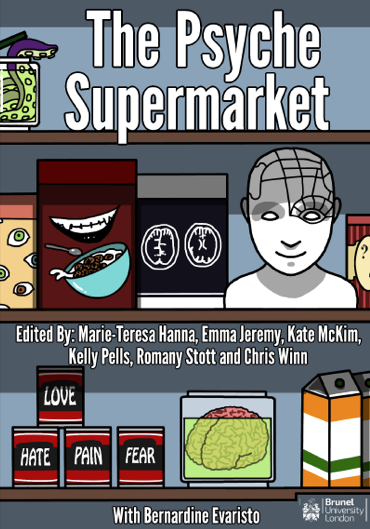
You can read Shrai’s short story, alongside many others, in The Psyche Supermarket released on the 11th of March.
Last year Dr. Bernadine Evaristo and a team of Creative Writing students brought us ‘The Voices Inside Our Heads’, Brunel’s first anthology of student-written short stories and thanks to its success, they’ve decided to do it again this year!
‘The Psyche Supermarket’ will introduce readers to yet another wave of young and creative student writers. There’s no boundary on what they can write which, mixed with their variety of backgrounds and personalities, will make for an eclectic collection of stories that range from the colourful to the downright bizarre. Love, comedy, fear and intrigue; these are just a few of the things you can expect to find down the aisle of ‘The Psyche Supermarket’!
The anthology will also be edited by a student team consisting of BA students Marie-Teresa Hanna, Kate McKim, Kelly Pells, Chris Winn and MA students Emma Jeremy and Romany Stott (who were also editors on the first anthology).
The launch of the anthology will be on the 11th of March at 7pm in the Antonin Artaud building as part of the monthly Arts @ Artaud event. As well as selection of readings from students in the anthology there will also other performances, not to mention the possibility of free wine. At some point in the night the anthology will go on sale at £5 but you’ll have to be quick because there’s a limited supply!
Something like this is a great opportunity for an aspiring writer and it deserves all the support it can get so please, if you get the chance to, drop by for a drink and watch some amazing new talent being showcased, maybe even grab a copy of the anthology.
For more updates on the anthology then check out the official Twitter account @CWBrunel or look no further than this blog where we’ll be hosting daily interviews with the writers featured in ‘The Pysche Supermarket’ starting the 16th of February!
When considering the craft of writing a Science Fiction piece, there are two crucial aspects to explore to develop your work of fiction. The first, of course, is a world in which your plot exists, commonly referred to as ‘worldbuilding’. Before writing a short story or novel within the Science Fiction genre, the explorative journey of creating and researching a world will inevitably create plot points. One example of this might be a world in which rules and regulations dictate the way your characters and act and communicate, such as the stifling society within Hugh Howey’s novel Wool.
The post-apocalyptic world Hugh Howey has created in his series titled Wool depicts a community who are living in an underground silo due to the toxicity levels in the atmosphere of the outside world. The society are divided by their job positions as each floor on the silo is dedicated to a different area of work, for example the professionally influential members of the society operate within the upper levels of the silo. Occasionally members of the community are sent outside in a protective suit to clean the dirt off the sensors, which reveal the outside world to the silo’s inhabitants, although they never return.
When reading Wool, the static world Howey creates within his novel has been created as a fragmented environment in order to hide the truth about the silo. In order to visit different levels within the silo, the characters must travel up or down a large flight of stairs because there isn’t a lift. This immediately indicates that the community live separate lives to one another and rarely communicate with people from other lines of work.
Another crucial element to consider when writing a piece of Science Fiction is the novum (a Latin phrase for ‘new thing’). In Science Fiction, the novum is the new idea that will be explored in your story. In Ernest Cline’s novel Ready Player One, the novum is the immersive virtual reality called the OASIS which provides a utopian escape from the world in which the characters live.
The novel is set in 2044 where people live and seek refuge in the OASIS, created by the eccentric James Halliday who is obsessed with 80s pop culture. After Halliday passes away, many OASIS users embark on a competition rife with 80s pop trivia and questions which Halliday designed himself in order to find a winner for his fortune and the OASIS itself.
Wade Watts, the novel’s protagonist, becomes involved in an epic journey to uncover Halliday’s riddles and the novel follows his progression in the competition and his personal development. As the novel is written in first person, readers explore Wade’s world and the OASIS through his perspective. One of the ways in which Cline contextualises the world is the explanation of the items required for a user to enter the OASIS: visors, haptic gloves and the console itself. When Wade places the visor over his eyes, readers are only able to explore his actions and communications within the OASIS.
Chloe Sizer – Science Fiction in Film
There’s more to science fiction cinema than great hulking aliens and epic space wars. As a whole, the genre has helped to shape the film industry as a vehicle for social commentary, as well as lead the way in special effects technology. However, it took a few decades before the genre was taken seriously.
Science fiction films appeared early during the silent film era. Initial attempts were of short duration often with a technological theme and humorous tone. Le Voyage dans la Lune by Georges Méliès is considered to be the very first science fiction film with its ground-breaking special effects pioneering the way for future films.
But it was the 1970’s which changed science fiction cinema forever. The emergence of George Lucas’s Star Wars pushed the genre to new extremes by mixing fast paced action with drama and romance. This ultimately made the film more marketable to a wider audience. On the other end of the spectrum, Ridley Scott’s Alien envisaged something far more sinister with some of the most horrific creature design ever seen on the big screen.
After Star Wars, there was a resurgence of interest and science fiction became bankable as a cinematic genre. Star Trek was now reborn as a film franchise and some of the greatest films ever made were produced as a direct result. Below are three sci-fi films which are my all time favourite.
1. E.T the Extra Terrestrial
In my opinion, this is one of Spielberg’s finest. It’s a film I was enamoured with as a child and something which I can re-watch over again. It was a widely successful film during the 1980’s telling the story of Elliot, a lonely boy who befriends an alien stranded on earth. It is thought that Spielberg drew the main plot of the film from his parent’s divorce with major references to his childhood interwoven throughout the film: Elliott fakes illness by holding a thermometer to the bulb in his lamp while covering his face with a heating pad, a trick frequently employed by the young Spielberg. Overall the film stands alone as a family classic, but you don’t need me to tell you that much.
2. Ex Machina
A fairly recent addition to sci-fi cinema, released in 2015 by writer and director Alex Garland. Ex Machina tells the story of Caleb, a young computer coder, who wins the chance to spend a week in the house of Nathan, the CEO of the company whom he works for. Whilst he is there, Nathan asks Caleb to test his new experiment, an A.I humanoid named Ava. It is a typical ‘man vs machine’ sub-plot, but the cinematography is beautiful and the acting is on point with Oscar Isaac portraying the sociopathic Nathan down to a T.
3. Black Mirror
Okay, so I may be cheating slightly here. Black Mirror isn’t ‘technically’ a film, but it is a TV series which is most definitely worth a watch. Charlie Brooker challenges societies obsession with digital culture with a wholly horrific ‘what if’ type scenario. What if you could re-create deceased loved ones using their past tweets and statuses? What if you had a chip behind your ear which recorded each and every event in your day to day life? Although a very harrowing series, it is still definitely entertaining and if you like dark, satirical comedy it is most definitely up your street.
Brunel’s first poetry anthology, newly titled Crush, is hosting a cover competition for Brunel students! The winner of the competition will win an invitation to the launch event and a free copy of Crush. This a great opportunity to add something a little different to your CV!
As there ins’t a singular theme that unites all of the poems apart from the expression of new talent, we are looking for original designs that display the student’s own interpretation of the title.
If you have any questions relating to the cover competition then don’t hesitate to contact us!
Would you be interested in taking part in Interflora’s Valentine’s challenge and create romantic verses for Valentine’s Day? Interflora are hosting a competition where writers could have a poem published in Interflora’s Little E-Book of Verse on their website. One participant could also win a new iPad Air 2!
Their ‘Verses for My Valentine’ campaign seeks to encourage people to create thought provoking poetry when writing messages to their loved ones. Rather than writing a clumsy Valentine’s Day message or borrowing cheesy lines from a favourite RomCom, they are challenging people to craft a beautifully thought-through verse that expresses their emotions concisely. The verses can be created in any genre, from a traditional romantic verse to a witty rhyme.
If you would like to enter the Interflora Valentine’s challenge, all you need to do is construct a creative verse in less than 150 words and send it to Laura Sephton whose email address is included at the bottom of this post. Submissions must be emailed before midnight on Tuesday the 27th of January. All entries will be judged by a panel of leading experts, including the Poetry Society and a well-known TV psychologist.
Interflora are also running a separate Twitter competition starting on Friday the 13th of February where they are challenging budding Twitter poets to create a romantic verse in 140 characters.
If you are interested in receiving further information about either of these opportunities, please contact Laura Sephton at Laura.Sephton@interflora.co.uk.
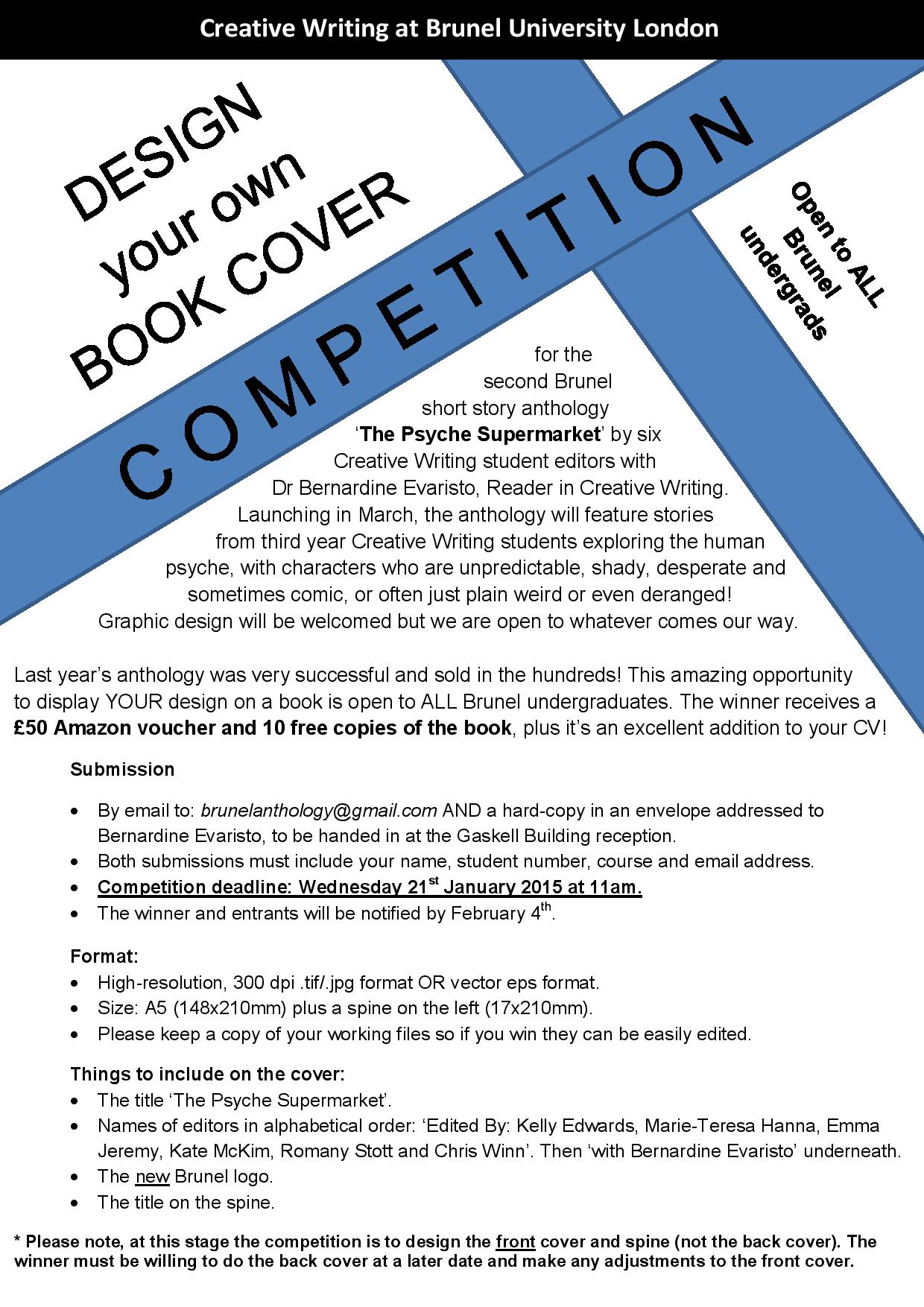
If you’re interested in design, Brunel’s second short story anthology are hosting a competition in which you design their book cover! If your design is chosen, you could win a £50 Amazon voucher and ten free copies of the book! Here are the details you need if you want to get involved:
For more information on ‘The Psyche Supermarket’, their Twitter handle is @CWBrunel.
Three third year Creative Writing students are currently seeking submissions for a poetry pamphlet that they’ll be publishing in March 2015. The deadline for submissions is January the 16th at midnight. We’re also hoping to organise a launch event for the pamphlet where all of the published poets will have the opportunity to meet one another and read their poems aloud. Submission guidelines:
3-4 poems per person (of which two will be selected for publication).
Poems must be less than 40 lines.
The poems must be your own original work and must not have been published elsewhere. (Simultaneous submissions are welcome, but if you are given an offer of publication elsewhere, please notify us on the first instance).
There is no set theme – the topics you write about are entirely your choice!
All submissions must be sent to: brunelpoetry2015@gmail.com If anyone has any questions then you are welcome to email the editors at the address above. You can also follow our Twitter page where we will be posting updates on the entire process, each step of the way. Our Twitter handle is @BrunelPamphlet. We are looking forward to hearing from you and reading your work. Kate McKim and Brunel Poetry Pamphlet’s editorial team.
I only really considered Screenwriting once I had written a novel: Hitman which came out in 2000. I had always been interested in film but I had never really considered Screenwriting as an option.
Two things happened which made me want to get into it. The first thing was that I got some interest in Hitman when an independent producer asked me to write a film treatment for it and I couldn’t afford to pay anyone to do it for me. So, I thought ‘How hard can it be? I’ll do it myself’ little realising that it is really not that easy. The second thing was that I met a screenwriter called Marc Pye (The Bill, Eastenders) and as I tried to get into Screenwriting he helped me and became a really good friend and sort of mentor. It wasn’t really a conscious decision and I think, as is often the way with screenwriters, I just fell into it.
Act of Grace, this was your first feature film?
This is my first feature film and thus far the only feature film of mine to be produced but it wasn’t the first feature film that I had written, or rather, co-written.
How did you find the process?
Well it was a really unusual process because I hadn’t originally been involved. Again it was working with Marc and we had been working on another project of his called Scallies which was a TV drama we were developing for Granada TV. Marc had been working with a writer and producer called Alan Field. They had both worked with Jimmy McGovern (Cracker) on the first series of The Street and were developing Act of Grace as a low-budget feature film. Alan had raised the funds and it was a few weeks before they were due to shoot and they wanted somebody to help on a new draft of the script. So, Marc introduced me to Alan and I was asked to do a rewrite. Normally it’s the complete opposite and you work on something for years before it gets made but on this I was working on it for literally a few weeks.
Is it easier to collaborate with other screen writers?
I don’t really mind, it depends on the project. As a screenwriter you have to be prepared to collaborate; it’s not like being a novelist or a poet or something else which can very solitary. You’re part of a team and you have to be prepared to share nicely!
Were there any disagreements?
Not on Act of Grace; there was nothing major. I mean the story was pretty much there, I was just working on some characterisation, reordering some scenes and I was very much the junior partner so I couldn’t really change that much nor did I want to as the story was fairly strong already. But yes you often do get disagreements, not so much with fellow writers but with producers who often look at things from a different perspective as they are the ones who are holding the cash.
Has there ever been a time when you have been kicked off a project?
Oh yeah, I’ve been sacked a couple of times! You just have to deal with it. Most writers at any level will have been kicked off a project at some point. Working in the creative industries, you have to develop a thick skin and you just have to take it in your stride.
One time I found particularly galling was where I had been hired by an American producer who was a successful business man who just fancied becoming a filmmaker by way of a hobby. He employed me to work on a script and he didn’t really know what he was doing and when I got sacked it was a bit of a pain. But you just have to deal with it.
If you’re working on something and they say to you ‘we need to get a fresh pair of eyes’ it basically means ‘we’re getting someone else in’ [laughs]. You know it does happen but as long as the project goes on and does well and gets made, even though you are sharing your credit with someone else, then it’s fine. Screenwriters don’t generally have a problem with that. As long as they don’t murder the script – which can happen.
Baptism – your new feature film. How is that progressing?
Baptism is hopefully, touch wood, progressing well. It’s an adaptation of my novel of the same name, and The Philm Company have made a spec trailer which they do a lot of nowadays in order to raise funds. So they use actors which won’t necessarily be in the final cast but they shoot something which they can then show to financiers alongside a script. So a spec trailer was made, and I have to say it was a really great one.
Was adapting your novel a difficult process?
Not really because I was, you could argue, always cynically thinking that Baptism could be made into a film and even some of the people who have read the book say it reads like a film. Having said that, the book is a ten and a half hour read which means you have to lose a hell of a lot of the book to compact it into a two hour screenplay.
I loved adapting it though. Adapting it with Phil Hawkins who is the director/producer was a dream because he’s so good and we both kind of share the same vision for the story.
Did you liaise with the director a lot on Baptism?
Yeah I went and had some very long meetings to talk things through and Phil and his producer/business partner, Alex Baranska, would provide me with lots of notes. But as I say the notes were so good, when you get good notes you don’t struggle and you don’t have a problem with accommodating them. The worse thing is when you have a producer who is just starting out who thinks they are better than they really are and then they give you notes which don’t really make sense, which you don’t necessarily agree with. That’s when things get tricky.
Is it easier when you are writing to relate to places which you already know?
Funnily enough I have just been asked to rewrite an old script of mine that was set in London so that it’s set in Belgrade. I’ve never been to Belgrade so that was hard. Generally speaking, it is always easier to set things where you can picture them in your mind’s eye. Having said that if your story is really good and you have enough knowledge about a place which looks authentic in the script then you can get away with it.
Have you ever had to change a screenplay to work around a certain actor?
When I was working with Rik Mayall we wrote scripts very much with him in mind and that was fantastic obviously, working with him was a dream come true. I have worked on a few projects where they have had an actor in mind and so you tailor it slightly to that actor and then they say that actor has dropped out which happens a lot.
Do you have any other projects in the pipeline?
I have another co-written feature script, Alleycats, which I’ve been developing for many years with director, Ian Bonhote and producer, Andy Ryder. This is due to shoot in March in London and casting is taking place as we speak.
What is it like to live as a Screen Writer in Britain?
You have to be able to work very hard in short intense bursts for certain deadlines and you have got to have a very thick skin in terms of rejection. I would recommend though, especially to those who are just starting out, to have some sort of day job as it can be very precarious. You have to be incredibly single minded and not give in.
Could you name one good thing and one bad thing about Screen Writing?
Good thing is to work in a fascinating industry doing a fascinating job. If you love storytelling and you love films then it is a dream come true. I’m a firm believer in if you do something you love then you aren’t really even working. So that’s a prize to be coveted.
In terms of a bad thing it would be the precarious nature of the work and the cash flow. Sometimes you might be commissioned to work on a project and not get paid until a year later. The hours are long and the wages pretty low in the independent sector but you just have to keep on writing and honing your craft and hopefully, you’ll get somewhere.
I have some interesting events and opportunities which I would like to share with you all.
Brunel – Women for the Future
Join Brunel University London on the 3rd December for a relaxed evening of networking with students, staff, researchers and external business women alike with a chance to hear from keynote speaker and entrepreneur, Roisin Issacs.
From humble roots as the oldest child in a large Irish family to philanthropist and entrepreneur, the heart-warming star of TV’s “Secret Millionaire” Brunel Alumna Roisin Issacs will be sharing her story of her extraordinary life journey.
Roisin will share the highs and lows on the road to her success with tips on what works, what doesn’t and sometimes how it’s simply just a matter of plain hard graft!
PBS National Poetry Competition
The 2014 PBS National Student Poetry Competition http://poetrybooks.co.uk/projects/45/ is now accepting entries. Judged this year by one of the Next Generation Poets 2014, Jane Yeh, the competition is open to all UK students in Undergraduate or Masters level education.
Entry is free for Student Members of the Poetry Book Society, which is also free to join http://poetrybooks.co.uk/membership/33. There are cash prizes and PBS memberships on offer to the top three as well as book bundles and Associate Memberships for Eight Highly Commended poets:
First Prize: £200 + Full PBS Membership
Second Prize: £50 + Full PBS Membership
Third Prize: £25 + Full PBS Membership
Highly commended: Associate Membership + book bundle
The deadline for entries is midnight on Monday 13 December. The twenty best poems will be published in an e-book and a celebratory event will be held at the winner’s University (terms and conditions apply).
If you would like to audition for a role in Brunel Drama’s aptly named play “A Midsummer’s Wet Dream” then please attend Drama Societies meeting on 7:30 AA103 on the 11th November. This will be to write you name under the role(s) you wish to play. Auditions will then be held Wednesday/ Thursday of the same week, around your timetable. If you can’t make it Tuesday, let us know via Facebook or Email.
ALSO for all you budding screenwriters out there we are hoping to create lots of short film/ sketch scene scripts, which will then be handed over to Louis Batten-Foster, who will ultimately be in charge of making it an independent, student creation. You guys will play God, essentially. We will be holding a meeting for the Screen Writing project at 6PM AA103 TUESDAY 11TH.
This project meeting is to discuss what we want from it, what levels of involvement you guys want, and to talk general ideas.
Core concept for these shorts is this: A Happy 5-10 Minute short. It can be comedic, it can be uplifting, it can be enlightening, but over all they need to be positive.
So please all get involved.
To finish I want to add in a plug for my future blog posts which will be published sporadically over the next couple of weeks. I am hoping to conduct a series of interviews with students and staff who have a personal insight into the film and creative industries. As well as being an entertaining and interesting read I am also hoping that this will be informative and helpful to any current/future creative writing students.
Interested in adding to your portfolio? We are looking for people interested in writing articles for the various categories and sections of the online magazine – http://www.lamerde.co.uk
Several Brunel students have already started writing for us, and we would like more! Where better to start than Brunel Writers!?
La Merde is a non-profit independent magazine aiming to publish articles that you and other students would want to read . We are also looking to fill various positions within the team over the coming months, something that you may be also interested in?
Writing for us will give you a host of opportunities to display your range of skills, creativity, and create an online reputation. It’s a great chance to add some great looking work to your portfolio and put some new skills on the CV before you finish Uni. We post far more regularly than other Uni related outlets and will be happy to link your social media/blogs to your name as you’re published.
Check out http://www.lamerde.co.uk for a good taste of our style and articles. Bear in mind it is only three weeks old!
If you’re interested do not hesitate to contact us: info@lamerde.co.uk
Or if you have articles that you would like to send to us: submissions@lamerde.co.uk
Or if you’d like to be part of the team, inquire via: recruitment@lamerde.co.uk