Hillingdon Literary Festival Creative Writing Competition

image002.jpgThe second Hillingdon Literary Festival is running a creative writing competition based on the theme, Writing Local / Thinking Global. The entries will be judged by a panel, including Benjamin Zephaniah, Philip Tew, Suzi Feay and Courttia Newland. The shortlisted works will be published in an anthology of the same name and available at the Hillingdon Literary Festival for free. The winner will receive a £250 prize too.

The word limit is 2,500. Submissions must be received by 15th August 2016. Please email: LiteraryFestival@brunel.ac.uk.

For more information regarding the competition and for details of the festival itself, please go to: www.hillingdonliteraryfestival.com. Over the course of the weekend, there will be over 28 acclaimed authors and poets who will be reading and discussing their work. All sessions are free and there will also be food and drink available at the Duckpond Market along with books to buy, signings, live music – and sunshine guaranteed!

The Brunel Writer Prize 2016

The Brunel Writer Prize is awarded to the student who achieves the highest graded non-fiction article submission for the Creative Industries module on Brunel University’s Creative Writing programme. The piece of non-fiction should be ‘fresh, original, compelling and well balanced’. The winner of this year’s inaugural prize is Lorna Martin for her review of Jamie Lloyd’s recent production of Doctor Faustus at the Duke of York’s Theatre.

Congratulations to Lorna. Read the review below:
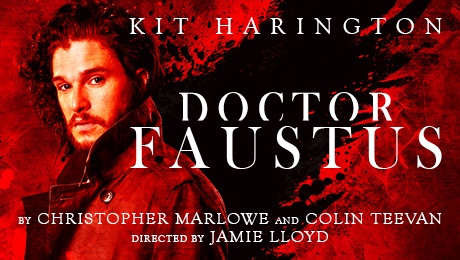
29937_fullWHAT THE HELL? – A REVIEW OF JAMIE LLOYD’S DOCTOR FAUSTUS (9th April – 25th June 2016)

Jamie Lloyd’s production is like a Faustian pact; it starts off with excitement and intrigue, but quickly descends into something awful. This review will contain spoilers.

The house lights fade. On stage, Faustus (Game of Thrones’s Kit Harington) lies on a bed, his eyes glued to a television screen, while his student and later personal-assistant-cum-love-interest Wagner (Jade Anouka) symbolically cleans in the background. The set is hyper-realistic, showing a mundane looking flat, bedroom and living space in front with a kitchen towards the back of the stage. So far, so intriguing.

The first section combines physical theatre, music and an imaginative use of the set to bring the pact scene to life. Harington’s Faustus, frustrated by his own weakness, keeps us interested throughout the initial monologue, and although the modern update occasionally felt forced (an Apple Mac instead of “my books”) the juxtaposition of the mundane setting and the devils constantly lurking in the background is deeply unsettling. Particularly effective is the rising chaos of the stage, which gradually got messier as blood and black powder was trodden everywhere by barefoot actors. What really drives these scenes though, is the power of Marlowe’s text. When that is replaced with Colin Teevan’s new scenes, the production completely loses its philosophical depth, moving from deep questions of morality to something more resembling a soap opera.

On its own, Teevan’s writing could have been good, and there were moments where his talent shone through. However, anything would pale in comparison to a play which has endured for over 400 years. I felt like I was watching two plays, with completely different characters and themes. The production’s focus on celebrity culture felt simultaneously irrelevant and too obvious; the bizarre scene where Faustus takes out six FBI agents in the shower left me totally confused. A few other questionable moments – a man playing a pregnant woman in a ridiculously camp falsetto voice, a borderline transphobic joke where a man and woman have their genitals switched, not to mention the unnecessarily graphic rape of Wagner – made this production uncomfortable for all the wrong reasons.

Jenna Russell’s Mephistopheles is moving, her speeches about losing God’s love especially poignant. Unfortunately, the play quickly becomes a love triangle, with Mephistopheles and Wagner suddenly competing for Faustus’s romantic attention. By positing Wagner as the symbolic ‘goodness’, the production attempts to make Faustus’s struggle between God and the Devil more understandable to a modern audience.

However, instead of tired old tropes which are at best boring, and at worst sexist, I wish I had been trusted to understand that Heaven and Hell were metaphors that could stand alone. I wish that Marlowe’s subtlety and the beauty of his writing could have been more than just an opening and conclusion tacked on the end. Frankly, I wish the production had been more mature, subtle and true to the themes of the text. The two angels in the opening scenes were a beautiful and original take on a concept which could easily feel out of place in a modern production; clearly it was possible to update the play without rewriting it. I would have loved to see Lloyd’s take on certain scenes from Marlowe; instead, by the second act I was ready to sell my soul to the devil in exchange for being allowed to leave.

In the play, Faustus’s time on Earth seems to fly by inhumanly quickly. Unfortunately, the same cannot be said for this production. When the curtain finally fell, I heard the woman sitting next to me mutter, “What the hell.” I have to say I agree with her.

Lorna Martin
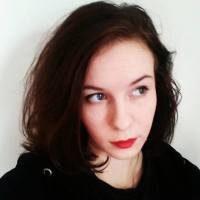
13412880_1694405824115089_5482601924258505113_nLorna Martin is usually writing something creative or having opinions. Her current projects include developing a short horror screenplay for Lincoln Japan Festival, and working on her first poetry pamphlet. Lorna’s work has been published in Roulade Magazine and you can read her film reviews at Blueprint: Review.
The London Writers’ Café Turns Ten by Linnéa Nilsson

It’s time to put on your best party hat and bake that cake, because The London Writers’ Café is turning ten this month.

It’s been a decade since Susan Jones, a playwright, set up The London Writers’ Café. While it started as a group for Jones and her friends to share work, it has since grown to almost three thousand members.

In 2010, Lisa Goll took over as the group’s leader and organizer. With her background in marketing for publishing and media companies, she has been able to take the community forward and expand. ‘It’s great as a creative writing group but it’s even better when it develops, when it helps people develop,’ she said.

As a member of The London Writers’ Café you have an array of formats to choose from. They do feedback sessions where some members read their work. ‘It’s up to people, there’s never any pressure to read,’ said Goll, who moderates these meet ups. ‘I make sure that it’s all really constructive and the person goes away with some positive notes and perhaps some room for improvement.’

There are also workshops to attend, run by professional teachers and lecturers giving classes on specific Creative Writing topics. But that’s not all; Goll also organizes talks by publishers, literary agents, editors and authors, giving members a chance to learn more about the industry and make connections.

Another perk of joining is the LWC’s sponsors. Goll revealed that ‘some of them offer special discounts and offers for members. You get access to organisations, competitions and information that perhaps it’d be harder to find if you’re on your own.’

The group is diverse, catering to all types of fiction writers, from novelists to screenwriters, from playwrights to poets, the forms are broad and varied. Goll is confident that this mixture is strongly beneficial for the members. ‘They can learn from each other,’ she said. But it’s not only the forms that set the writers apart. Goll revealed that ‘they’re different ages and from all different backgrounds. They’re all from very beginner up to people who have perhaps finished one novel, they’ve even published one novel and working on a second.’ Some have gone down the self-publishing route while others have now secured an agent.

Anyone can apply as long as they live in London and have started working on a project. ‘If they’re just thinking about writing or they’ve always wanted to write but haven’t actually started, then I would say that they’re probably not quite ready for us,’ she explained. The group is the perfect space for any Creative Writing student to receive more invaluable feedback from fellow writers outside of their university course.

You might be thinking that it’s all work and no play, but that’s not the case. ‘I’ve made a lot of great friends in the group’, said Goll. ‘That’s a really nice thing to have, a group of friends who you can just talk about writing and really geek out [with]’. They often have a drink and talk after sessions in a more relaxed setting, adding to that strong community bond – something that Goll adores. ‘I think it’s all about getting writers from all over to come together’.

What’s the future for LWC? According to Goll, quality is the main priority. ‘I think [it] works best when we have just a couple of sessions that are very well formed, so that’s what we’re going to focus on this year. It’s going to be more about quality feedback sessions and making some talks and workshops that people really need. In terms of the next twelve months, that’s where we are. Beyond that, I’m never sure. It goes in completely its own direction. It kind of has a destiny all of its own’.

After a decade of helping writers advance and develop, The London Writers’ Café’s birthday is definitely something to celebrate.

For more information on prices and dates visit The London Writers’ Café’s website HERE

Screening: Xiaolu Guo’s UFO IN HER EYES

What: Screening and Q&A

When: Tuesday 24th May at 5-8pm

Where: Antonin Artaud 003

As part of next week’s Brunel Festival (http://www.brunelfestival.co.uk) there will be a free screening of  Xialou Guo’s ‘UFO in Her Eyes’, a feature film about a peasant woman in a Chinese village who claims that she has seen a UFO. As a result everything in her life and that of her community undergoes a tremendous transformation. The film explores identity, feminism and globalisation.

Xiaolu Guo has created a vocabulary of her own, both visual and linguistic, that reflects her sense of bXiaolu Guoeing caught between Chinese and English, and her experience growing up during her home country’s wild transition from totalitarian enclave to the new shrine of global capitalism. An “alien” at home and in the global intellectual elite, Guo is an ideal interpreter of the sense of alienation generated by social upheaval and globalization“- Toronto Film Festival, 2011

Xiaolu Guo wrote the novel, script and directed the film and will available for a Q & A session after the screening; a great opportunity to pick an acclaimed novelist and scriptwriter’s brains, as well as see an award winning film. Don’t miss it!

“UFO in her Eyes is surrealist and ironic, but also pierced with melancholy and beau­tiful photography. With startling detail, Guo reshapes reality into a hyper-vivid portrait of chaotic contemporary Chinese society.” – Toronto Film Festival

 To learn more about the author: http://www.guoxiaolu.com/index.htm.


Short Story Competitions: Only a Click Away by Linnéa Nilsson

Do you write? Do you have short stories laying around, unused and unread? Are they blocking your door? Are you currently unable to enter your bedroom? Do you have to sleep on the sofa? Do you want to get your stories read and also win fantastic prizes, like MONEY? Do you want to sleep in your bed again? Well look no further, because with a few simple clicks you can enter short story competitions all over the world.

It can be difficult to find out about ongoing writing competitions; even with fancy sites such as Google, the search for the right contest can be a long one. But fret no more! Christopher Fielden is coming to the rescue.

Fielden is a writer, just like YOU, he writes short stories, just like YOU, he’s been published and done well in competitions, just like – well maybe like you, but if not go to his website and this could be YOU.

Unlike a lot of us, Fielden has not been lazy. He’s done the hard work, ensuring that we don’t have to search any more. The wait is over; he’s brought the competitions to the people. If you’re anywhere near anything with an internet connection (which you probably are because you’re reading this) then I would urge you to head over to his website (by clicking HERE) and take part in the extensive list of short story competitions that he has provided.

But that’s not all. You’ll also find out if you have to give up a few pounds from your precious student loan or if entering a contest (and moving closer to world domination) is going to be what we all love: FREE. A maximum word count and where in the world the competition is, as well as its closing date, is provided. You no longer have to search and search for a suitable place for that thriller/sci-fi/western story about a secret agent space cow from Texas that you’ve written, because Fielden will point you in the right direction and tell you what genre every contest accepts.

So head over to Fielden’s website and win some stuff. It’s obvious that you want to, so go on. You can do all this from bed (when you can enter your bedroom again) without changing out of your Frozen pyjamas. Could it be any better?! Also, please remember us when you’re rich and famous.

Christopher Fielden’s list of short story competitions can be found HERE.

The Imagination Project

Second and third-year Brunel students have been working with staff to create Brunel’s third annual short story anthology, The Imagination Project.

This anthology is the brainchild of none other than Bernardine Evaristo, MBE FRSL FRSA, author of The Emperor’s Babe, Blonde Roots and Mr Loverman. But it’s the students that wrote, submitted and edited the stories as well as designed the anthology and organised a FREE launch night for it!

The launch is on the 15th of March at Brunel University, in the Antonin Artaud building, room 001, at 6pm. Everyone is welcome to FREE DRINKS and there will be readings from the anthology, which are available to purchase for just £5! So come, show your support, and enjoy the night!

You can follow the lead-up to the night at @BrunelStories on Twitter

The Danish Girl 2015 [Short Movie Review]

danish_girl-2

I walked into the cinema knowing absolutely nothing about the movie except that it was about a transgender woman. I didn’t even watch the trailer. My friends asked if I wanted to watch it and not being one to shy away from anything new I decided to tag along.

The Danish Girl is a British drama film based on the fictional novel of the same name by David Ebershoff, which was loosely inspired by the lives of the Danish painters Lili Elbe and Gerda Wegener. The film is set in mid-1920s Copenhagen, where a man, Einar, while standing in as a female model for his wife, begin to realize that he is in fact a woman trapped in a male body. This is when everything starts to unfold; the film explores the struggles of Einar and Gerda’s relationship, the troubles they face and the sacrifices they make.

This movie caught me off guard in the most poignant and magical way. I walked in the cinema with the idea that the film was going to be about a man becoming a woman, but in actual fact the film was really about deep, unconditional love. I was completely captivated by everything the movie offered: the cinematography, acting and story-telling meld together to produce something so enchantingly beautiful.

I don’t want to give anything away but when my friends broke down during certain points of the movie I remained stoic and unrelenting. Not because I didn’t feel moved but because I felt a sadness for the characters so heavy that I didn’t know how to show my emotions.

There is a reason why the film and cast have gotten so many nominations and clinched their fair share of awards; The Danish Girl showed me exactly what love is, and what it could be.

VERDICT: 4/5
The film kind of drags on around the middle, but picks up a little later on.

Jojo Chia

Calling all budding designers: Cover Design Competition

The Creative Writing department are currently beginning the exciting process of developing this years anthology ‘The Imagination Project’ which features a range of second and third year students’ stories. The anthology launches on the 15th of March 2016.

The competition for the cover design is open to all Undergraduate students and as well as seeing your design used on all copies of the book, you can win a £50 Amazon voucher and 10 copies of the book. Plus if you’re an aspiring graphic designer it’s a great addition to your CV.

The anthology includes a diverse range of work so, as the title suggests, let your imagination run wild!

The design needs to be:

  • High-resolution, 300 dpi .tif/.jpg format OR vector eps format.
  • Size: A5 (148x210mm) plus a spine on the left (17x210mm).
  • Please keep a copy of your working files so if you win they can be easily edited

And must be submitted by Monday 15th of February at 5pm to Dr Bernadine Evaristo via email (Bernardine.Evaristo@brunel.ac.uk) AND in hard copy form in an addressed envelope handed in at the Gaskell reception.

For further information on what your submission must include please check out the link: http://www.brunel.ac.uk/cbass/arts-humanities/creative-writing/creative-writing-anthology-competition/_nocache

Good luck & happy designing!

Book Adaptations- Is TV The Future?

Emma Challis

The past few months have been full of news when it comes to the world of book adaptations. For Harry Potter fans there’s been plenty to get excited about, with the release of the first wave of ‘Harry Potter and the Cursed Child’ tickets, which sold out in minutes, and the first glimpses of ‘Fantastic Beasts and Where To Find Them’. Both look to be a promising extension of the much-loved series, with Oscar winning Eddie Redmayne taking the lead as Newt Scamander in the spin-off movie ‘Fantastic Beasts’.

Other exciting news has been the announcement of a BBC adaptation of the ‘His Dark Materials’ series by Phillip Pullman for television. After the 2007 film ‘The Golden Compass’ was generally regarded as a disappointment by fans and critics alike this could be another chance for beloved characters Lyra Belacqua and her daemon Pantalaimon to  delight on screen as they did in the books. There’s also potential for the other worlds included in the trilogy to be seen on screen for the first time.

This announcement follows a recent increase in books awaiting to be turned into TV series; another contemporary children’s classic ‘A series of Unfortunate Events’ by Lemony Snicket is in the running to be a Netflix original series by 2017.

It’s possible that this increasing movement to TV adaptations of books is because ongoing series offer more opportunity to stray true to the original stories than films as each episode allows for a chapter to unravel. There is also potential for character development to be shown over a longer period of time, which has proved popular in other TV series adapted from books such as ‘Game of Thrones’ as well as originals like ‘Orange Is The New Black’ and ‘Breaking Bad’. This also opens up the shows beyond fans of the books they’re based on, which could lead them to prove more popular than spin-off films like ‘Fantastic Beasts and Where To Find Them’.

However, TV series can lack the large budget that the film industry offers which has caused other projects, such as the adaptation of Neil Gaimen’s ‘American Gods’, to be put on hold. There is also the threat of a series being cut half-way through if ratings fall which is a particular problem in the American TV industry.

Whichever form proves more popular it’s safe to say that these upcoming projects are ones to watch!