Guest Blogger – EMMA FILTNESS!: ‘Keeping it Local’ – Event

Hello fellow writers,

I am a Creative Writing PhD student, a part-time lecturer in English and Creative Writing, and Brunel’s Publications Officer. I came here originally to do the Creative Writing MA and loved every minute of it, so I stuck around for more.

It is shaping up to be a busy but fun start to the 2014 academic year, and I am here to tell you about some great community Creative Writing and Arts events that are happening at Brunel and in the surrounding area over the next month or so, with the hope that some of you might come along and maybe even take part! I have been working quite a bit lately with the wonderful Charlotte who is Arts Programming Officer for the local borough (Hillingdon), and she is keen to get Brunelians involved…but let’s start with me, me ME!

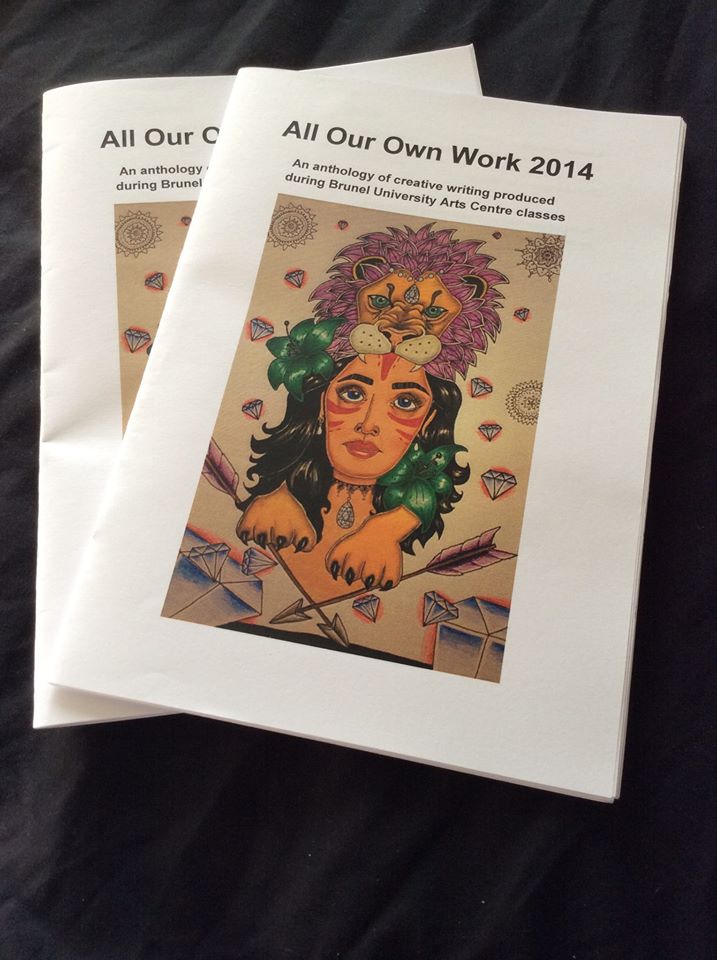
1. As well as teaching some of you for modules such as Introduction to Writing Fiction and Drama, I run a weekly Creative Writing class at Brunel’s Arts Centre. Classes consist of themed writing exercises, prompts and related activities suitable for all levels of experience. Classes are open to all Brunel students, staff and members of the local community. If you are an arts student at Brunel, you can come to the class for free (yes, FREE!). You may want to sign up soon, though, as places are limited (classes begin Tuesday 30 October, 6pm). These classes are ideal if you want somewhere to try out ideas and have the space to write without the pressure of looming deadlines and grades. I make a little anthology of work produced on the course each academic year, so these classes also give you the opportunity to see your work in print (I will even furnish you with a spare copy so you can give one to your mum). View the Arts Centre web pages to find out more, or email me (contact details below).

ArtsCentreAnthology

2. Charlotte is running Bigfest, a one-day festival in Uxbridge town centre on Sunday 28 September, 2014. There will be music, theatre, street performers, a food market and, most importantly, a live literature tent! Brunel writers and locals will be reading poetry or prose between 12 and 4pm. I will be reading a short story from my thesis (stories based on the life stories of little old ladies), Joe Norman who is an English PhD student, lecturer and Brunel’s Communications Officer will be reading a short story (once he manages to find one of his that is suitable to be heard by delicate, innocent ears and does not make people want to be sick) and Brunel Creative Writing MA alumna and local journalist Barbara Fischer will read to you from the memoir she is currently working on in which she recalls her time as a “hack”. Come along and listen (again, it is FREE!) or, if you are feeling brave, why not sign up to read a story or poem? If you would like to give this a go then email me soon so we can reserve you a slot (contact details below)

Bigfest2014

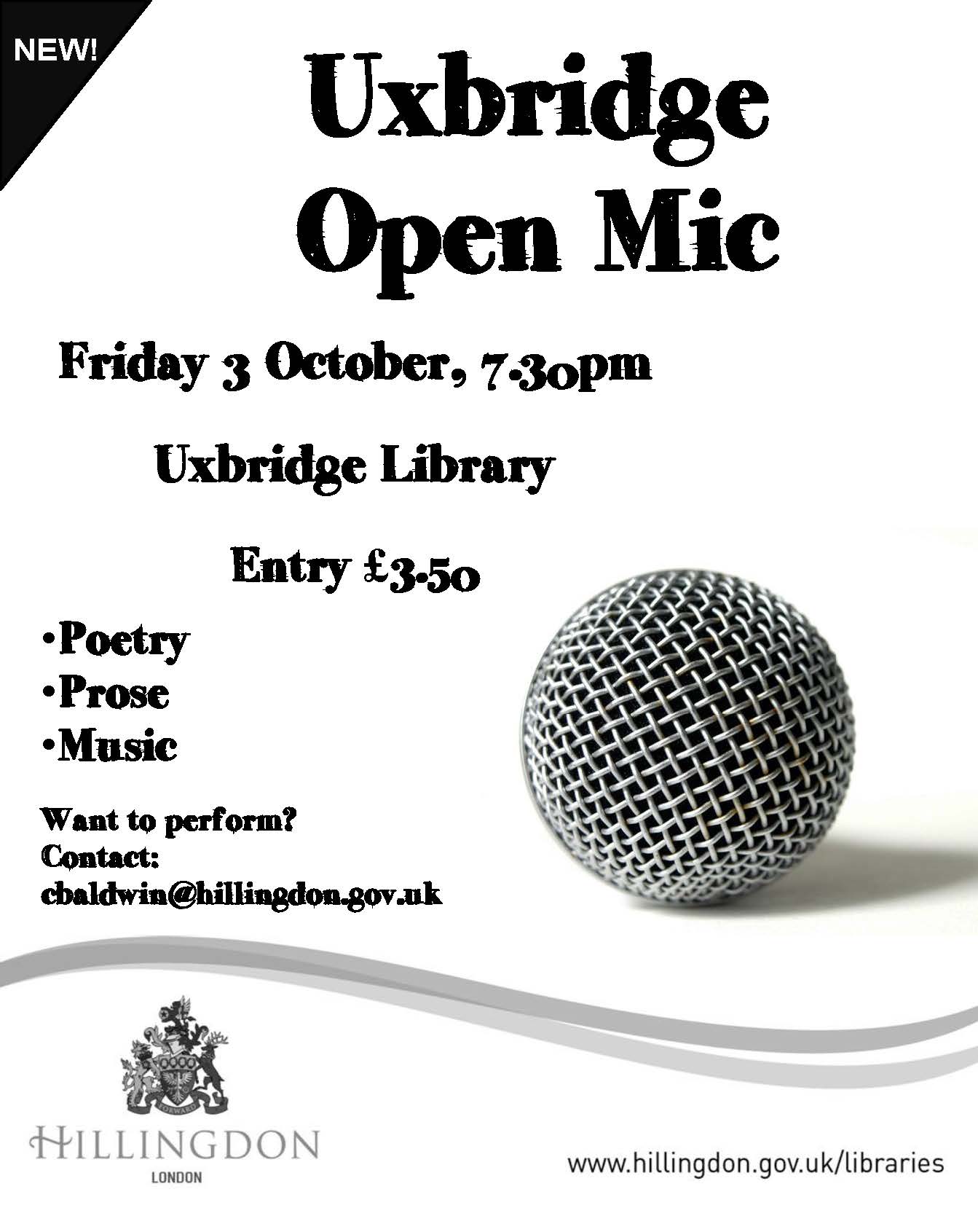
3. Charlotte has also set up an open mic evening at the newly-refurbished Uxbridge Library. The open mic sessions will run every other month or so, with the first one taking place on Friday 3 October at 7.30pm. You don’t need to book, just turn up, pay the teeny tiny £3.50 entry fee (it is free if you sign up to read/sing/strum), and listen to poetry, prose and other acoustic offerings from local writers and musicians. Again, if you are feeling brave and fancy reading, strumming or singing, then let me know and I will make sure there is a slot with your name on it. There will be some empty slots left for those of you that prefer just to rock up on the day and see how you feel…

Open Mic Poster

I should probably stop there before I wear out your eyeballs…if you want to know more about any of the above then please send me an email at E.Filtness@brunel.ac.uk

Please also keep an eye on the Brunel Library blog for information on the Brunel Author Series…thanks for “listening” and I hope to see some of you at one, some or all of these awesome local events!

Happy scribbling,

Emma

Q&A with Saera Jin!

Saera Jin is a Brunel MA Graduate who has gone on to great success in Japan as the main writer for Square Enix – famous for the Final Fantasy and Dragon Quest series.

            “The game producer was looking for a new writer, strong on originality, and according to them, that was me!”

She has recently attended the Cannes’ Film Festival to promote her second short film which she wrote and directed in London. “Seems like my Japanese-British hybrid set of ideas could take my writing career to better places.” We’ve been very excited to hear from Saera, and are very proud of her achievements. To find out more about her fantastic accomplishments, and where she will be going in the future, we’d invite you to ask your questions! This is a fantastic opportunity for Games Design and Creative Writing students, as well as those interested in film making.

I know I hope to have very similar experiences to Saera, and am very much looking forward to seeing what she has to say about breaking into such a lucrative industry, so don’t be shy! Ask your questions, either in the comments sections below, or tweet them to @brunelwriter, using the hashtag #QuestionsForSaera, and we’ll pose them to her in the coming weeks. Don’t forget to also follow Saera on Twitter – @saerajin.

Huge congratulations to Saera, long may it last!

‘If you fail to plan, you are planning to fail.’

While I have to agree with Benjamin Franklin for the most part, I did start wondering the other day about planning our creative work, and whether we were really setting ourselves up for failure when we just run with an idea without really thinking about where it’s going.

I’ve always loved writing, and until I started my dissertation I didn’t really plan what was going to happen. Sometimes I’d hit a bit of a wall or have some discrepancies in the story, but for the most part, I’d love being surprised by the twists and turns that happened along the way – sometimes it was even as if I was reading the story for the first time. That kind of writing is great because it’s fun and based on reactions, and let’s be honest, sometimes doing something without any real structure is really freeing, and can really lift your writer’s block.

However not planning what direction you’re going in can be really detrimental to your writing. If you have no guidelines, how do you know where to go next? I found this as I got further into my degree. I realised I didn’t have writer’s block just because it happens, I realised I had writer’s block because I didn’t consider which direction I was going to take in the long run.

I don’t think I would have done as well at university if it hadn’t been for the screen writing module I did in second year. The level of planning that goes into writing a screenplay was something completely alien to me at first, but I slowly accepted the fact that I needed to adopt at least some level of structure (and the planning documents contributed to my final grade…)

Once I learned to plan, my work was completed faster and to a much higher standard, and while I still enjoy the freedom of not planning, I can’t actually do it any more. Even something as simple as a blog post, which used to be like stream of consciousness when I’d write on emphaticpanda.blogspot.com, has become a process which begins with a title, followed by in-depth bullet points before I finally open a ‘new post’ tab and actually write down what I’m thinking.

I found a happy medium between planning and having the freedom to be surprised by what I’m writing however. I think it was one of my tutors who suggested we wrote the key events of our narrative on post-it notes and stuck them to the wall, then we knew what would happen, but if we got bored of the storyline we could move around some of the key events to shake things up. Planned freedom. A strange oxymoron.

What do you think? How meticulously do you plan your narratives? Get in touch in the comments, or tweet us at @BrunerlWriter

Dear Freshers,

Congratulations on your fantastic A level results, they are well deserved.

congratulations

It’s not long now until you’ll set foot on Brunel’s campus as an official student, but until then, you have the a few weeks where you’re likely to feel nervous and excited all at once. Here are a few things to bare in mind during your fresher’s experience.

freshers

1. You’re only a fresher once. I mean it lasts a whole year but that’s no excuse to rest on your laurels! Now, fresher’s week, and uni in general is what you make it, so if you want good grades you have to work for them, but during your freshers year it really doesn’t hurt to go a little bit wild. Of course, don’t take ‘go a little bit wild’ as an excuse to get arrested or hurt anyone, I mean just have fun, but stay safe. Definitely stay safe.

2. You’ll make really great friends. This is something that will happen really quickly, especially if you’re living on campus because you’re all in the same boat. You’re all away from home, all with people you don’t know and possibly wouldn’t even mingle with normally, but there’s something about halls that means you’ll have at least one good friend in there. On the first day I moved in, I was very shy and nervous, but as soon as I said hi to a couple of people I felt fine. Everyone’s going to be friendly for the first couple of weeks, and if at any point people stop being friendly/ sociable, you’ll have met the people on your course by then, and they will be great.

3. Sometimes in halls people can be noisy. This is something that you kind of have to roll with. During the day you probably won’t notice it so much because you’ll have music on, or you’ll be out or there will be that general hum of day to day life. However, (and I was very lucky with my whole building) there will be some noisier individuals. If you’re a light sleeper, I would recommend ear plugs. If you get the foamy ones you can still hear fire alarms through them so they’re okay in terms of your safety as well.

4. With that said, fire alarms happen. This is one of the least fun things that happen while you’re living in halls, and I’m not speaking from a noise perspective. In my halls, we had four fire alarms. Three were at night, while it was raining, while I was not wearing shoes. Once someone shared their slippers with me. That is as strange as it sounds. They aren’t entirely unpleasant though, I mean the whole building is outside so you can socialise for a bit. One tip though – if there is a fire alarm in the afternoon, make sure it goes on for longer than about 30 seconds because they test the fire alarms once a week, and I knew a few people who got half way down the stairs in towels after being caught in the shower…

5. Socialise. What I will start off by saying is that I came to Brunel being very shy and socially awkward, I didn’t know what to say to people, and I always assumed they wouldn’t like me anyway. That made socialising more difficult, but then there came a point where I relaxed and realised that at uni, there are very few people who really judge you, and those who do aren’t worth your time anyway. The people who do accept you and who you do get along with are worth your time and are worth socialising with. There were so many times in first year when we’d stay up all night watching films as a flat rather than going out and they were some of my absoluter favourite times and some of my best memories. Being social will do wonders for your sanity, trust me.

6. There’s more than one way to be social. Don’t think that when I say ‘socialise’ I mean go out every night and consume copious amounts of alcohol if that’s not what you want to do. If it is, fine. If not, get your flat mates together to watch a film, walk to town, join all the societies and sports teams you want to. Basically fill up your time with lots of different things and lots of different people. If sport isn’t your thing, there are so many societies, there will be one that is your thing.

7. If there isn’t a society you like, make one. It’s actually pretty easy to get a society together, if you’ve got a handful of people with similar interests and time and energy to put into it, you could have yourself a successful little society.

8. Don’t worry. Your first year of uni is about fun, and it’s about finding yourself. As cliché and wishy washy as that may sound, it’s true. So don’t worry. Of course put the work in, you got this far and let’s be honest, you’re paying for this, so definitely put the work into this. What I mean is don’t burn yourself out in your first year. Of course you want to be proud of yourself, of course you want your parents/friends/family to be proud of you, that’s natural, but burning out won’t do anyone any good. Leave that for third year when the end will be in sight.
9. Sometimes there might be pranks and practical jokes. That’s fine and it’s all fun and game but make sure A. you don’t take it too far. It’s not a joke if someone gets hurt, and B. don’t let security catch you – always have a lookout.
I could go on for ages about how great Brunel is and how much I’m sure you’ll love it here, but you’ve got some celebrating to do! Huge congratulations to you all, once again. If you have any questions, please don’t hesitate to tweet @BrunelWriter for things related to the course, or tweet me personally @EmphaticPanda, and I will be happy to answer any questions about anything Brunel/freshers/uni related.
In case you’re in need of it, or know anyone who is, here’s the clearing hotline for Brunel university – 01895 272273, and the webpage, should you need further information. Best of luck! http://www.brunel.ac.uk/clearing-adjustment-courses-2014 
We look forward to seeing you around campus in a months time!

Dissertation…

Now, soon-to-be-third-years, I know what you’re thinking – ‘it’s the summer break, I’ve got ages to think about/plan/write my dissertation!’ – and yes, you’re right. You should be enjoying your summer – reading things you want to read, binge watching TV shows, catching up with your friends at home, or getting ahead with your third year reading list. By all means do those things. But don’t rest on your laurels – dissertation will come around sooner than you think!

Of course it’s a big project, but you’d be surprised how quickly you’ll run out of words when you start writing about something you care about enough to spend months researching, planning, writing, rewriting, proofreading, rewriting again, cutting, and redrafting. I know I’m probably making this sound terrifying, but dissertations are actually kind of fun in a strange way, and seeing them all bound and looking official is extremely rewarding.

So, what can you do to make the process of writing a dissertation easier? Here are a few things I learnt while writing my dissertation.

Disso

1. Don’t leave it until the last minute. April will come around extraordinarily quickly – you might think first and second year went quickly, but third year is on a completely different level, it will go in a flash. It’s best to at least start thinking about what kind of area you’re interested in now, or if you know what you want to write about, start jotting down ideas, find yourself some secondary sources, verbalise your ideas to others.

2. Verbalise your ideas to others. Sometimes you’ll have a brilliant idea for your project, but you won’t realise how half-formed it is until you say out loud what the idea is. This is where others come in, they can ask questions, highlight potential flaws and offer some advice. You’ll end up with a stronger project if you include at least one other person. This is of course where your academic advisor comes in handy, but discuss the idea with your peers as well, it’s so easy to get wrapped up in what you’re doing and not notice the pitfalls. In my project, there were glaring continuity errors that I hadn’t noticed until someone pointed it out.

3. With that in mind, don’t take criticism personally. It’s easy to take criticism personally. Especially with creative projects because you made them, you created them, and when someone comes along and tells you it’s not actually perfect it’s easy to feel upset. It’s okay to feel upset, but realise that they’re your friend and they care about you, they want you to do your best and they’re not being nit-picky for the sake of it. Utilise their feedback, and offer them feedback too. As much as it’s a solo project, you’ve come this far together, and this is the time that you’re all going to need support the most.

4. With regards to suggestions, you might not agree with some of the advice you get from some people. This isn’t a time to get defensive, but rather say ‘I don’t really know if that will work, I know it might seem out of place/weird/not quite cohesive now, but I plan for such and such to happen later on.’ This is another way of developing and discussing your ideas with people, and it’s this kind of thing that you can write in the accompanying essay. ‘It was suggested that I alter this bit, however I felt that…’

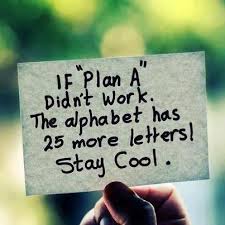
5. The plan you submit in October is important. I know – 5% seems like nothing, and October might seem a bit soon to be telling people your intentions for something that isn’t due for six months. Let me break it down for you though. If you submit the plan, you get A* for that section. If you don’t submit a plan, you get a big fat 0. When my grade came through, it was at the high end of the boundary. When all the components were added together, the A* that I got just for handing in my plan pushed my whole grade into the next level. Also, what you hand in in April doesn’t even have to resemble what you wrote in your plan. If you say you want to write a story about squirrels and use Winnie the Pooh and Toy Story as your inspirations, no-one will bat an eyelid if you submit a short story of half a film about murderers, using Fatal Attraction and Clockwork Orange as your sources. (But don’t they sound like fun projects?) Basically, JUST SUBMIT THE PLAN. It could be the difference between a low 2:1 and a high 2:1, or a high 2:1 and a 1st.
Plan A

6. As I said above, you’re free to change direction. We’re creative writers, and we can’t be tamed or held to down to one idea. I was lucky enough to change my idea in September but even then, the central idea of the film I wrote changed beyond recognition. Two of my friends got to January and had a sudden epiphany that their new idea was better for them. That being said, if you get a new idea in March, you might want to weigh up the pros and cons of starting this new project. Do you think this is better than your existing project because it’s new or because it’s actually stronger? Is it worth turning your back on everything you’ve already done? Have you lost interest in your project because you’ve been working on it for so long, or has the story actually run its course? One of my other friends changed his idea in March and got a very good result. You have to know yourself. I can only liken dissertations to relationships – if you’re not happy, get the hell out!

7. Ask for help if you need to. Help can come in many forms, if there’s a bit you’re not sure of, ask someone to read over it. The worst they can say is ‘I don’t think it works’ which is what you thought anyway. Also, that’s what your academic advisor is there for, you’re not bothering them by asking them for pointers and advice and your project will be stronger for the advice of others.

8. Make sure you give yourself enough time to proofread and redraft/edit. That’s pretty self explanatory. As Earnest Hemingway said – ‘The first draft of anything is shit’. I agree, and when you proofread your dissertation, it’s not a twenty minute thing. Really proofread it. Read it out loud, you might feel stupid but it’s one of the best ways to spot typing errors or general mistakes. I’m the worst for writing stuff like ‘of’ instead of ‘if’, ‘the’ instead of ‘there’ and I once wrote Beyoncé instead of Beyond (it had been a long day). Check it, check it, check it. Edit it, then check it again. This is important.

9. Your supporting essay is just as important as your project, give it time and attention. It’s the only place where you can explain some of your choices and justify leaving that line in, or giving that character that trait/task/death etc.. Make sure you justify all your choices, include research you’ve done, discuss things you learned, talk about things you’ve changed, consider what professionals in the field have said about your genre/craft etc.. Make sure your referencing is on point. Also to add to the points you make in the essay, include things in the appendix to show your development, research and maybe visual clues about characters or locations. My appendix was slightly bigger than my whole project. (Sorry Max Kinnings.)

10. Don’t leave it until the last minute. I know I said this already, but I’m serious. Sometimes, as students, we get distracted and end up staying up late into the night, sometimes all night to finish/write an essay for a module which is 2,000 words. Let’s be honest with ourselves here – that’s not the best method for those essays, and it’s hard and tiring and frustrating. Do you want to be doing that with something five times the length? What if you get writer’s block?

11. One of the best ways to make sure you get things done in more manageable chunks is to set aside one morning/ afternoon/ evening/ day/ night/ whatever time frame you work best on a week, go to the library with your friends and do some of your project. Be it looking online for information about the best murder techniques, finding books about infectious diseases or watching episodes of Dora the Explorer on YouTube to help form your ideas. Even if you’re only there for an hour and a half with a twenty minute sandwich break in between, It’ll be far more constructive than spending three whole days stressing out over it every couple of weeks. The best way to motivate yourself to do work is to show yourself that you’ve done some work.

12. Finally, enjoy it. It’s something you can really get your teeth into, show what you’re passionate about, and really show where your strengths lie. Then when it’s done, have a big drink/ dance/ pizza. Just celebrate.

success

Best of luck, and enjoy your final year at university!

Things They Don’t Tell You About Graduation

With Brunel’s graduation week having just passed, it seems the perfect time to share some insight which I gained during my own ceremony, which I had very little idea about before the actual day.

graduation

1. It’s a pretty long day but it will go in a flash! Don’t forget to bring a camera, and make sure you take all the photos you possibly can. Especially don’t forget to have a photo with Isambard Kingdom Brunel himself – it’s a staple part of leaving Brunel.

2. You’ll feel pride like you’ve never felt. That’s pride in yourself, in your classmates, in the school that you’ve been a part of, and in the university as a whole.

3. You’ll feel in awe of the people graduating their Master’s degrees, and those receiving their PhD, you may even feel inspired to go on to postgraduate study. (Don’t forget Brunel students receive a discounted fee if they further their study at Brunel)

4. You’ll be standing and walking more than they let on, so wear comfortable shoes. Or wear really impressive ones and carry a spare pair in your bag.

5. Wear waterproof make-up! Even if you don’t cry, you’ll get hot in the robes and some of your make-up will do its best to escape.

6. The complimentary drinks aren’t bad at all!

7. Even if your entire family can’t make it, they will be proud of you and you’ll probably feel so much love from them in the lead up to your graduation (and afterwards) that it will be like they were there all along.

8. Try to eat breakfast. It’s easy to forget or just decide not to if you have a morning graduation as you’re expected to register and collect your gown between 8:30 and 9:30, so the morning is a rush. The ceremony goes on until about 12 o’clock though, so at least make sure you’re hydrated. The robes are hot, you’re probably wearing warmer clothes than you typically would be on a hot day and there are a lot of people in the room. Having something in your stomach is going to be better than sitting there very hungry and possibly even light-headed.

9. I was extremely happy that we had to walk up and down a slope instead of steps to shake hands with the officials, but in the event that you do have to walk up steps, I refer you back to point 4 for the shoe warning.

10. The certificate you’re given is in a folder and isn’t rolled into a scroll. The scrolls are fake and only for photographic purposes.

11. Finally, just enjoy the day. There will be a lot of rushing around, it will be stressful at times and it’s easy to let that affect your mood. Take a deep breath – get your robes, take some photos, laugh at what you all look like wearing the mortar boards, and then realise you’re all actually pulling it off quite well. Get your tickets, meet your guests, take more photos and enjoy it. As I mentioned in point 1 it goes in a flash, enjoy every moment of your success, and the success of those around you.

Credit: Brunel University Facebook Page

Huge congratulations to the Class of 2014, may your lives be richer for knowing each other, and may your future be as rewarding and as beautiful as you want them to be. Best of luck with whatever comes next.

Screenwriting Competition!

Entries for the 2015 BlueCat Screenwriting Competition are now being accepted from all over the world. Prize money for the winner is a staggering $10,000, while three finalists will each be awarded a cash prize of $1,500.

All entries will receive written feedback on their scripts. Scripts submitted by the first of September will receive feedback by the 1st of October.

Short films must be between 5 and 40 pages and cost $40 to submit, while feature length scripts cost $60. Students are eligible for a discounted short film submission price of $35.

Check out interviews with 2014’s Winner Jennifer Cui, and finalists Jeremy Lerman, Athenia Paris Mekarnia, and Wenonah Wilms

For submission information, click here.

Recent achievements by BlueCat Alumni include:

  • Aaron Guzikowski’s #1 Film “Prisoners,” starring Hugh Jackman, Jake Gyllenhaal, and Melissa Leo, was released in September 2013. He is also the creator of “The Red Road,” a Sundance Channel original series.
  • Young Il Kim’s script, “Rodham,” a 2012 Blacklist Script, recently attached director James Ponsoldt (“The Spectacular Now”). Young recently won the 2013 Alfred P. Sloan Commissioning Grant from Sundance, where he will write a biopic on Stephen Hawking.
  • Ana Lily Amipour’s debut feature, “A Girl Walks Home Alone At Night,” premiered at 2014 Sundance.
  • Ashleigh Powell sold her script, “SomaCell,” to Warner Brothers, with David Goyer attached to produce.


Special thanks to Claudia Summerfield for this information.

Guest Blogger: Martha Salhotra – DEVISE

Hi everyone, I’m Martha, a soon-to-be third year undergraduate studying English at Brunel.

A few weeks ago, I started up a blog on WordPress in the hopes of creating a magazine-style website which showcased the work of young, aspiring writers and journalists. Interestingly, I was initially inspired to start this up after my time managing the @BrunelWriter Twitter feed, where I discovered the importance of students needing a chance to write for competitions, magazines and websites and so have something to showcase to potential employers as evidence of their writing apart from personal blogs or university work.

Devise

As an aspiring writer/journalist myself, I had learned how vital is was that I wrote for other platforms and had evidence of engaging with different companies through the written word – so I set out to create a similar kind of platform for other students of a similar age and below who were also seeking such opportunities, giving them the chance to feel part of a new community of like-minded aspiring writers and journalists.

I named the website Devise – I know, it’s not very original – but the word ‘devise’ brought to mind images of planning, thinking and creating, and this is the kind of ethos I wanted the website to take on. The concept of Devise is quite simple: we’re giving our voluntary and unpaid writers the chance to both write articles for us but also, better their writing while doing so. In return for our writers’ weekly contributions, myself and our Senior Editor Simran proof-read, edit and then provide feedback on their articles, suggesting room for improvement and helping them to get new and exciting ideas for their articles on the website. We aim to help these young people with their writing as they progress through their studies and strive to become professional writers or journalists in the future.

Although the website was initially aimed at young people – so those aged perhaps 20 and below – we’ve now taken on a few writers who have graduated from university and are in fact, full-time professionals. For example, two of our writers are graduates who work in PR and another two are graduates working with other magazines. This has proved the success of Devise as a website that appeals not just to students, but other keen writers who simply wish to contribute articles and help us grow. The mix of writers at Devise is fantastic, and although we are still targeting young people, we take on board those who simply wish to engage in their passion for writing.

The sections Devise currently has on the site include arts and culture, lifestyle, entertainment, fashion and beauty, sports, travel, food and reviews – and we expect the sections to grow as we take on new writers. We are always on the lookout for writers and with 16 writers currently contributing articles to the website, our team of editors is set to increase too.

Devise started off with small-scale intentions but is now developing into something amazing. If you are reading this and wish to gain writing experience on a voluntary, unpaid basis, feel you would benefit from getting writing experience and feedback on your writing or simply want to get involved as a writer, then email us at deviseblog@yahoo.co.uk. We also have a Twitter account that you can follow for updates and new articles: @DeviseBlog.

Lastly, please take some time to visit the website and read a few of the articles written by our outstanding writers. Remember, if you see yourself as a Devise writer, then get in touch!

http://www.deviseblog.wordpress.com

Poet in the City – Upcoming Events

bwlerhat_image

Poet in the City presents a series showcasing some of the most exciting new voices in poetry. Acclaimed International poets, rising stars, and some of the UK’s best new performance poets, will come together in a unique celebration of the power of words.

Come and experience poetry as you’ve never seen it before – inside London’s biggest bowler hat!

Living London – Monday 7th July 6.30pm – Living London is a celebration of some of London’s most exciting poets, writers and performance artists, in collaboration with Tilt. http://www.ontilt.org/

* Drawing on the unique Bowler Hat venue, the artists will explore London from all angles, from the surreal to the sublime! Living London will feature a live art performance by Stacy Makishi, flash fiction and wordplay by Femi Martin and poetry by Antosh Wojcik.

living_london

London Calling – Monday 14 July 6.30pm – Celebrating the publication of My Voice: A Decade of Poems from The Poetry Translation Centre, this event showcases the outstanding contemporary poetry written in three languages widely spoken in London: Arabic, Persian and Somali.
* Al-Saddiq Al-Raddi is widely regarded as one of the leading African poets writing in Arabic. His Collected Poems was published in 2010. A distinguished journalist, he was forced into exile in 2012 and now lives in London.
* Caasha Lul Mohamud Yusuf is one of the most exciting young poets of the Somali diaspora. She came to the UK in 1990 having fled the Somali Civil War and now lives in London.
* Reza Mohammadi was born in Kandahar in 1979. His three collections of poetry have gained him many awards, such as from the Afghan Ministry of Culture in 2004 and prizes for being Iran’s best young poet in 1996 and 1997.
* English translations will be read by Sarah Maguire (founder and director of the Poetry Translation Centre) and the poet Clare Pollard.

london_calling

How to Book:

Tickets for each event cost £8 and can be purchased via:

Living London

London Calling

For further information please contact Poet in the City on 0207 014 2812 or info@poetinthecity.co.uk

The Bowler Hat, Paternoster Square, London EC4M.
Nearest tube station is St Pauls.

BH_map

** Listen to Poet in the City’s informal Podcast with Antosh Wojcik – one of the youngest performers who will be at the Living London spoken word event – here: https://audioboo.fm/boos/2267780-living-london-interview-with-antosh-wojcik

** Follow Poet in the City’s Blog, Twitter account: @PoetintheCityUK, or Facebook page for more information about upcoming events.

** Follow @brunelwriter on Twitter for information about events, competitions and job opportunities in the world of writing!

A Guide to Surviving the Summer

No, this isn’t about safety abroad or using sun protection; (although we do advise those things) this is about how to get through the long summer months which fall between exam period and fresher’s week without losing your mind.

Summer

The last week of term after exams always feels free, and celebratory, but what then? What do you do from late May to September? Of course, a lot of students have jobs or internships, but in the last few years it has seemed more difficult to find these opportunities, which means you may lose motivation.

So what can you do? Well…

Write something – you have all the time in the world now to just write something you want to write, not because you’ve been told to, not because you have an impending deadline. You could write something fantastic that would get published, you could write something utterly terrible that you never show to anyone, that won’t get you a bad grade. You could explore and develop some of the things you wrote over the academic year (because don’t we all improve so much between week 1 and now?) The point is that if you do something which feels productive, it is likely to motivate you to do other productive things.

Take up a hobby – It doesn’t have to be a new craft, it can be something that slowly became less prominent as the academic year got more and more crazy. What do you love to do? Think about it, do you miss it? Do it. Again, sometimes it’s difficult to get motivated to even do things that you know you love doing when you feel like you have nothing to do, but seriously, go and make a pie, bake an upside down cake, build a computer, make your own dress, plant some vegetables. Seeing and holding the product of your own work is extremely fulfilling.

Read a book – Read two books, read ten, read a hundred. This is your opportunity to pick up any book in the world and read it just because you want to. Apart from being one of the best feelings in the world, it will still hone your reading skills and your writing skills. One of the first things I was taught at Brunel was ‘the more you read, good great or terrible, the better your writing will be’.

Do voluntary work – If you’re looking for actual paid work, then voluntary work won’t get in the way. It is flexible, it’s far easier to get into than a paid position, because in general, if you have the time, you are qualified. It will also look great on your CV and will get you out of the house for a few hours each week.

Start a blog – This kind of goes hand in hand with ‘Write something’, but then again, you blog doesn’t have to be for stories or your other creative work. You can take anything you enjoy and blog about it. Film reviews, books, games, crafts, cooking, health and fitness, nail art. The world, as the say, is your oyster when it comes to blogs, and it’s hard to explain how surreal and satisfying it is seeing views accumulate from all over the world.

Those are a few tips, hopefully they’re useful to you in some way. What are your tips for staying productive over the summer?

*** Don’t forget to follow @brunelwriter on Twitter for information about competitions, job opportunities and quotes of the day.

*** Want to contribute? Check out ‘Submit’ tab!