

Or: Please Remove Your Hands From My EQs
ON JULY 14, 2026 / BY EDITOR SOPHIE NAMBUFU / LEAVE A COMMENT
Every year, The Brunel Writer Prize is awarded to the student with the highest graded article submission for the Creative Careers module on Brunel University’s Creative Writing programme. Darcy Butler was a runner-up for The Brunel Writer Prize 2026, discussing her experience as a female DJ in her article, ‘Being a Female DJ’.
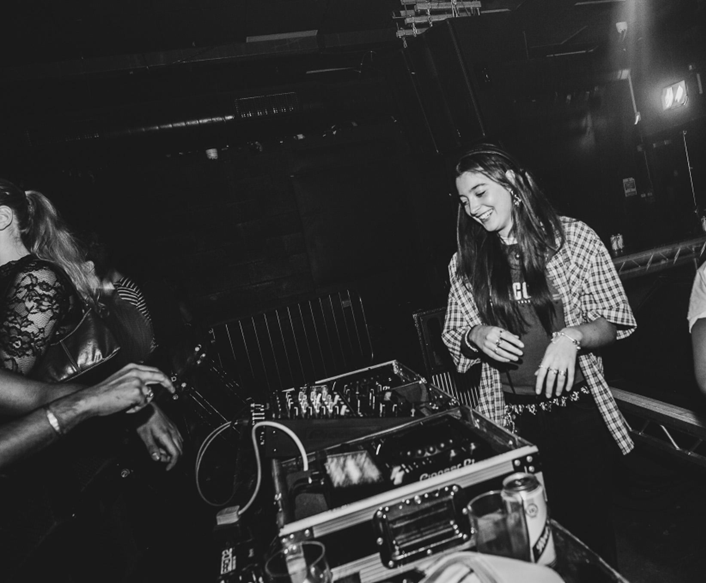
Credit: Simon Davenport
When people find out I’m a DJ, there’s always a pause. A gentle buffering symbol appears above their heads. Then come the questions. “What do you play?” Fair. “Do you sing?” Less fair.
“So… Who taught you?” Sir, I have Google and hubris like literally everyone else.
Before I’ve even plugged in my USB, the silent audition begins. Not of my music, but of my right to exist near expensive buttons. I must prove that I do understand what an EQ is and that I’m not here to gently stroke the mixer like a nervous horse. Men are rarely quizzed. Women are assessed like faulty appliances.
Almost immediately, a Booth Guy appears. He leans in way too close, breath seasoned with lager. He points at the mixer. “You know you can bring the mids down a bit?” Yes. I do, actually.
I deliberately haven’t because it sounds better. This confuses him. He touches a fader anyway. I die inside. Somewhere, a kick drum is weeping.
I once dated another DJ. Because of course I did. Silly me. You’d think that it would be collaborative. Instead, it became competitive in a way I never agreed to. “You only get gigs because you’re a girl,” he said, whilst asking to borrow my USB and my emotional resilience. Hear me now: romance isn’t truly dead, it’s just booked at 1am on a Saturday and insists on controlling my set.
Promoters are a mixed bag. Some are brilliant. Others behave like booking you includes some kind of backstage DLC. Hands appear on backs, waists, shoulders. None of these hands are attached to people who know what a gain knob does. In retaliation I usually adjust the low ends – red-lining the mixer. FYI: this is naughty, it can destroy the mixer. Passive aggression is best delivered at 128 BPM.
The messages I get deserve their own genre. One man repeatedly asked me to play at his event. Complimentary. Supportive. Until the sentence: “Come warm up with me in my studio ;). It locks from the inside.” This was pitched as a perk. Like good acoustics. I imagined being sealed into a room of tangled cables whilst he explained that “real DJs don’t use sync” and asked if I’d heard of vinyl, like it was folklore. Then there’s the late-night text from a man you thought was a friend. Always after midnight. Always midweek. “Are you still single? X” I don’t reply.
Getting gigs is rarely glamorous. Night buses. Empty platforms. Dragging gear through the dark like some cursed pack mule. Pretending to be on the phone. Perfecting a walk that says, “I am tired, but I will absolutely fight you with a flight case.” You learn which venues feel safe. Which promoters vanish and don’t pay you. Which toilets allow a discreet cry without an echo. And yet, when it works, it really works. When the bass hits so right. When the crowd moves as one sweaty organism. At that moment, everything else gets muted. The comments. The hands. The nonsense. Just sound, doing what it’s meant to do.

Credit: Simon Davenport
Playing alongside other women feels like instant kinship. We share stories and warnings. Guard drinks. But there’s also the quiet pressure of scarcity. One woman per lineup. Two if the promoter is feeling crazy and really radical. We cheer each other on whilst quietly wondering who’ll get the next slot.
Things I have been mistaken for whilst DJing:
- The singer
- Someone’s girlfriend
- Furniture
- A random woman who shouldn’t be in the booth (I have been threatened by security to be kicked out of my own set once before)
We don’t need permission.
We just need the next track.
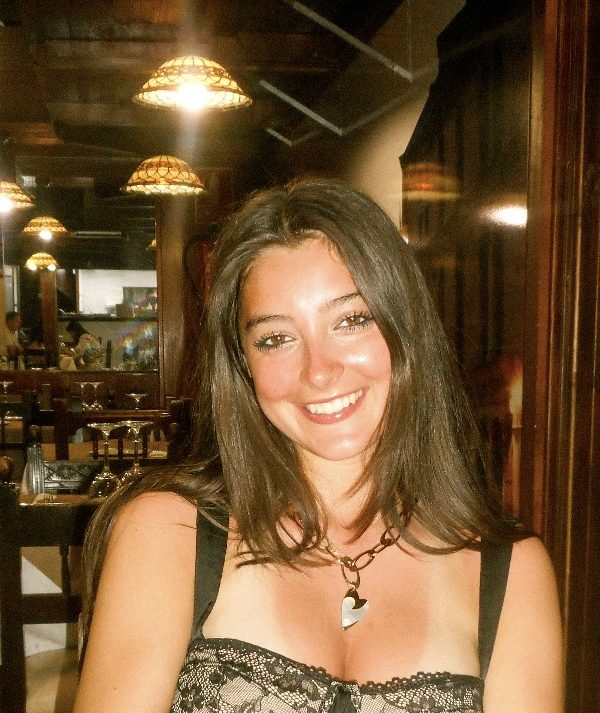
Darcy Butler is a 21-year-old writer, currently in the business of figuring things out, which is proving both inconvenient and quite useful. She writes poetry and prose about life, free will, identity, and the little horrors of being expected to know who you are.
Her work is drawn to the beautiful and the uncomfortable: the rotten fruit in the bowl, the open window, the possibility that everything could have gone differently. She is interested in breaking stereotypes, questioning what has been handed to her, and looking at the world slightly sideways – preferably whilst holding a pen!
Mostly, Darcy writes because she is curious. Also because the mind, left unattended, starts rearranging the furniture.
 Brunel Writer